















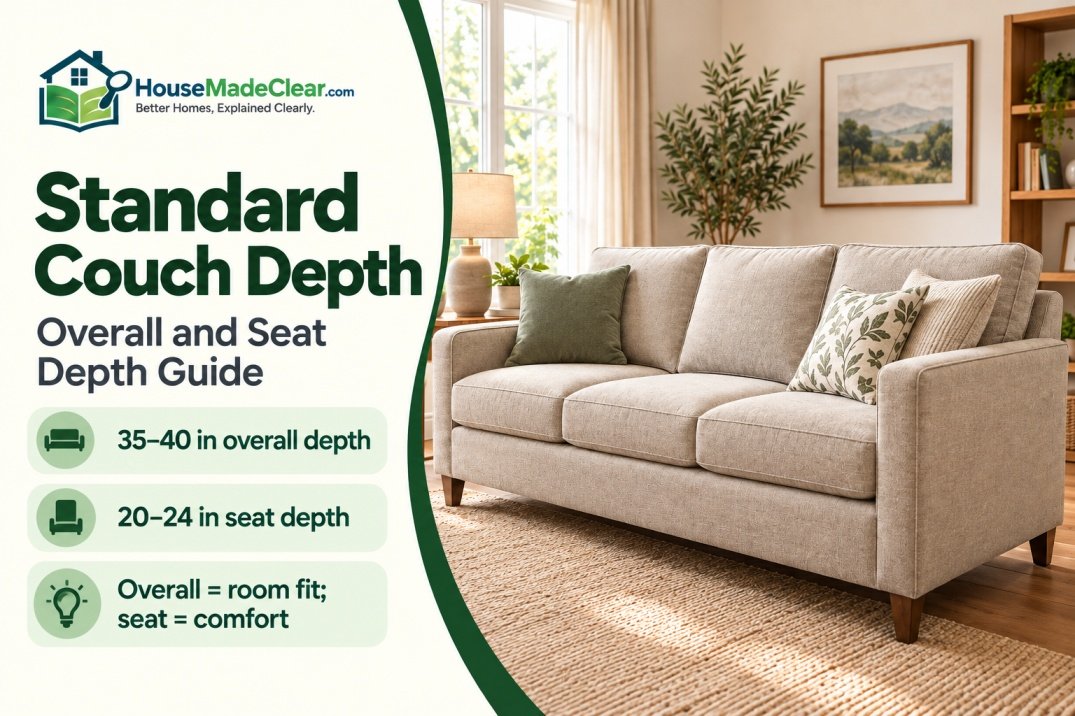
The standard couch depth is commonly approximately 35 to 40 inches overall, while the usable seat depth is generally around 20 to 24 inches. Compact sofas may be less than 35 inches deep, while deep-seat and lounge sofas can extend 40 to 45 inches or more into the room.
Overall depth and seat depth are not interchangeable. Overall depth determines how much floor space the couch occupies. Seat depth determines how upright, supported, or relaxed the couch feels when someone sits on it.
The right depth depends on the room, the user’s height, preferred sitting position, cushion construction and whether the couch reclines, converts into a bed or includes a chaise.
Quick Answer
Common couch-depth ranges are:
- Standard overall couch depth: approximately 35 to 40 inches
- Broader conventional range: approximately 32 to 40 inches
- Standard sofa seat depth: approximately 20 to 24 inches
- Upright or shallow seat: approximately 18 to 21 inches
- Deep sofa seat: approximately 24 to 28 inches
- Standard deep sofa overall depth: approximately 40 to 45 inches
- Extra-deep couch: more than 45 inches overall or approximately 28 inches or more of usable seat depth
These are common furniture ranges rather than regulated standards. Always verify the manufacturer’s overall depth, usable seat depth, cushion configuration, moving dimensions and delivery measurements.
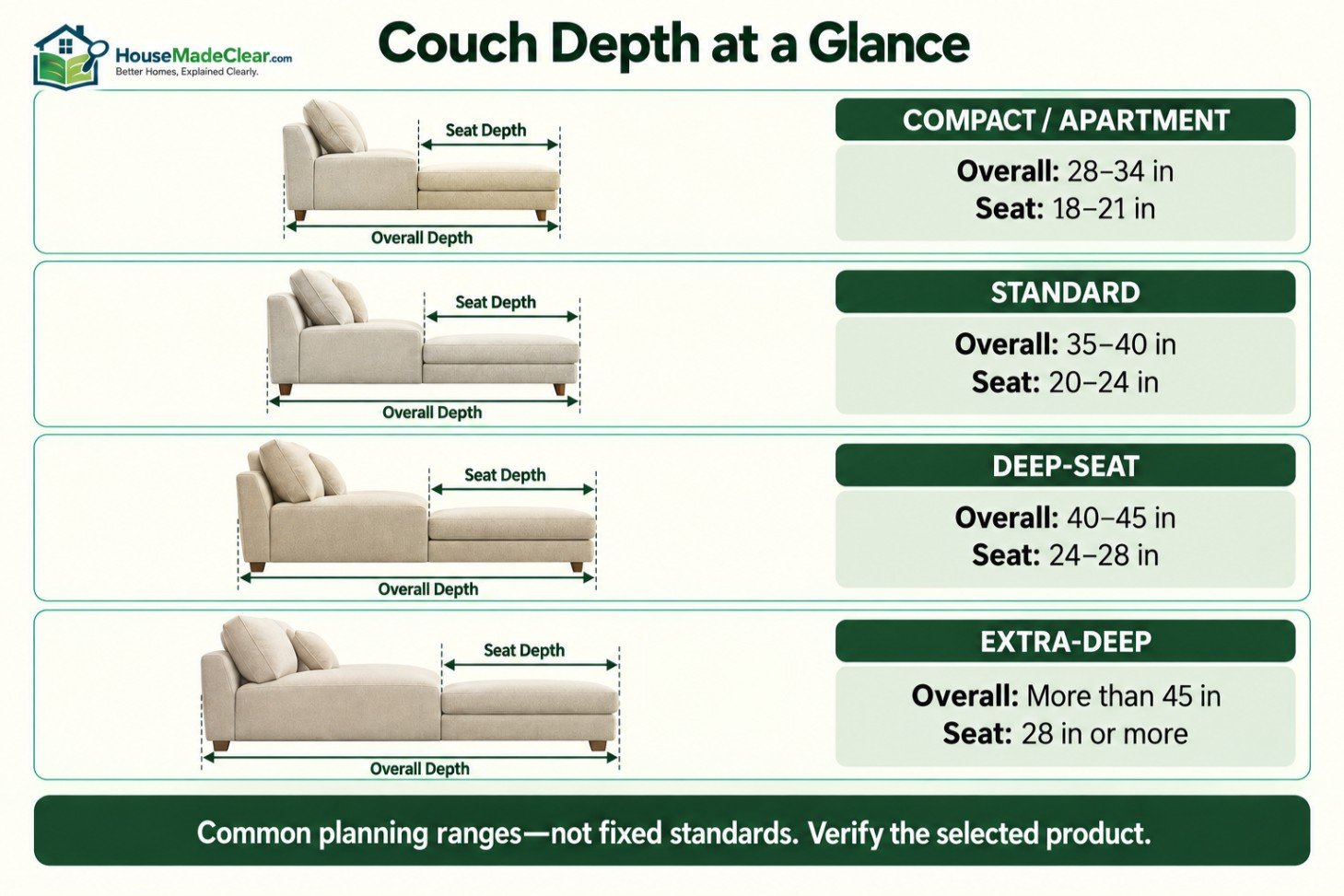
Standard Couch Depth at a Glance
| Couch Type | Common Overall Depth | Common Seat Depth | Typical Use |
|---|---|---|---|
| Compact or apartment sofa | 28–34 inches | 18–21 inches | Small rooms and upright seating |
| Standard couch | 35–40 inches | 20–24 inches | General-purpose living rooms |
| Deep-seat couch | 40–45 inches | 24–28 inches | Lounging, movie rooms and taller users |
| Extra-deep couch | More than 45 inches | 28 inches or more | Curling up, napping and relaxed seating |
| Reclining sofa | Model-specific | Model-specific | Upright and reclined use |
| Sleeper sofa | Model-specific when closed | Model-specific | Seating plus temporary sleeping |
| Sectional sofa | 36–45 inches at standard seats | 20–28 inches | Larger or modular seating areas |
| Sectional chaise | Commonly 60–75 inches long | Extended lounge surface | Full-leg lounging |
The ranges overlap because manufacturers do not use one universal definition of “standard,” “deep” or “extra-deep.” Compare actual measurements instead of relying on marketing terms.
What Does Couch Depth Mean?
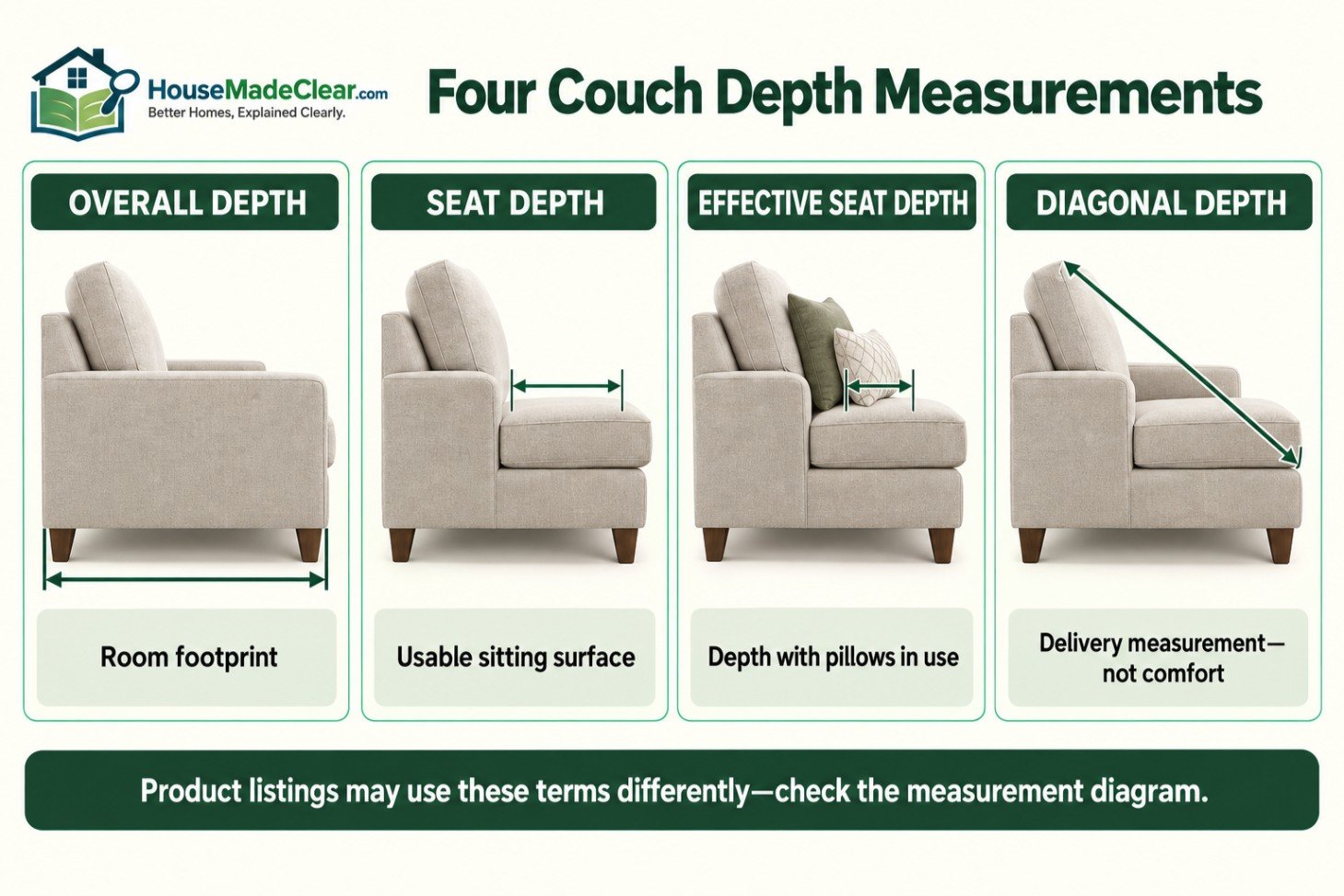
Couch depth can describe several different measurements. Product listings are not always consistent, so identify exactly which one is being provided.
Overall Couch Depth
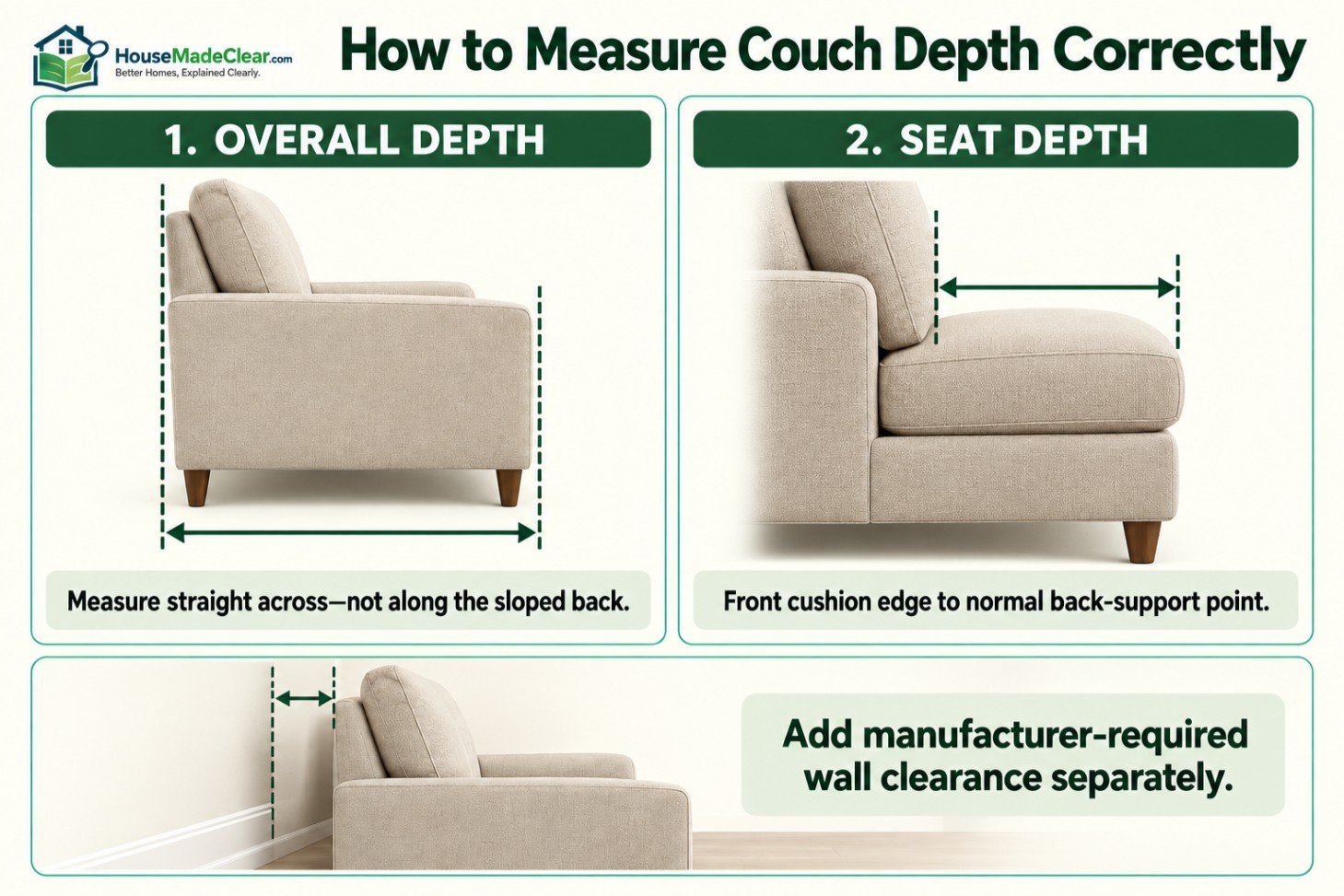
Overall depth is measured from the couch’s farthest rear point to its farthest front point.
It includes:
- Back frame
- Back cushions
- Seat cushions
- Front rail
- Upholstery
- Projecting legs or base
- Decorative trim
- Reclining components when closed
Overall depth determines how far the couch projects from the wall and how much floor space it consumes.
A sofa listed as 38 inches deep usually occupies approximately 38 inches from back to front, although additional wall clearance may be required.
Sofa Seat Depth
Seat depth is the horizontal distance from the front edge of the seat cushion to the point where the user’s back rests against the back cushion or inside frame.
This is the usable sitting area beneath the thighs.
Bassett Furniture’s seat-depth guide identifies approximately 20 to 24 inches as a common seat-depth range, with 25 inches or more providing a deeper lounging experience.
Seat depth has a greater effect on sitting comfort than overall depth.
Inside Depth
Some manufacturers use “inside depth” as another term for usable seat depth. Others measure it to the back frame after removing the back cushions.
Check whether the listed measurement includes the cushions.
A sofa may provide:
- 30 inches to the bare back frame
- 24 inches with standard back cushions
- 21 inches with extra lumbar pillows
All three numbers can describe the same couch in different configurations.
Effective Seat Depth
Effective seat depth is the space available when the couch is arranged as it will actually be used.
It can be reduced by:
- Loose back cushions
- Lumbar pillows
- Throw pillows
- Thick upholstery
- Cushion bulging
- Slipcovers
- Recliner padding
Effective depth may be more useful than the manufacturer’s bare-frame measurement.
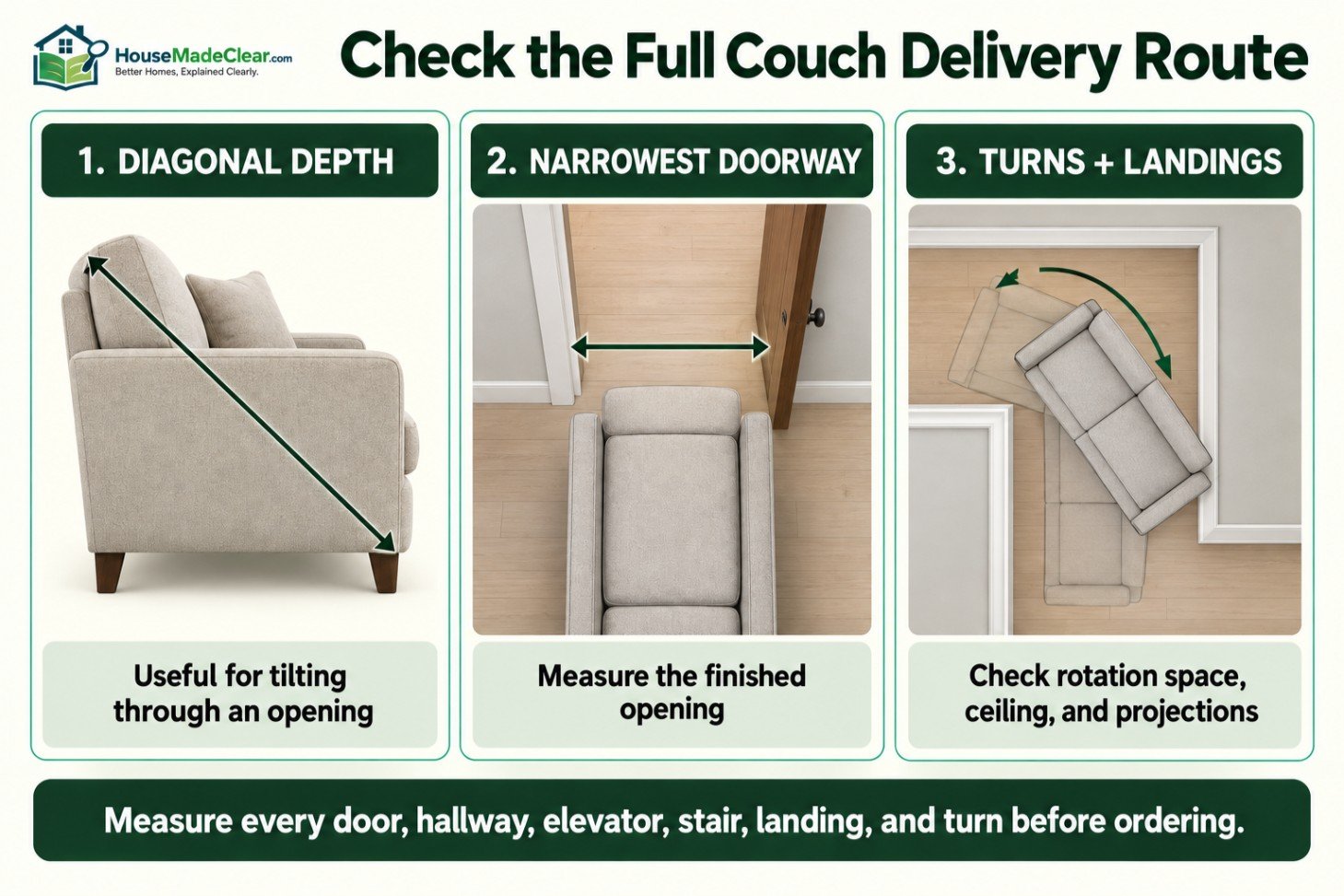
Diagonal Depth
Diagonal depth is primarily a delivery measurement.
It is commonly measured from the highest point at the back of the sofa to the lower front portion of the frame. This measurement helps determine whether the couch can be tilted through a doorway or hallway.
Diagonal depth does not describe seat comfort or the normal floor footprint.
Standard Couch Depth vs. Standard Seat Depth
Overall depth and seat depth answer different questions.
| Measurement | What It Tells You |
|---|---|
| Overall depth | How far the sofa projects into the room |
| Seat depth | How much usable sitting space is available |
| Effective seat depth | How much space remains with cushions and pillows installed |
| Diagonal depth | Whether the couch may fit through the delivery route |
| Reclined depth | Total footprint when a recliner is open |
| Sleeper depth | Total footprint when a sofa bed is extended |
| Chaise depth | Length of the sectional’s extended lounge portion |
A couch can have a large overall depth without having a particularly deep seat. Thick back cushions, a tilted frame and a substantial rear structure can consume much of the measurement.
For example:
- Overall depth: 40 inches
- Back structure and cushions: 17 inches
- Effective seat depth: 23 inches
Another couch could also measure 40 inches overall but use thinner back cushions, producing a 26-inch seat.
Never estimate seat depth from overall depth alone.
What Is the Average Overall Couch Depth?
Many conventional couches are approximately 35 to 40 inches deep overall.
A couch around 36 to 38 inches deep often balances room efficiency with a comfortable seat. Models closer to 40 inches generally feel more substantial and may provide a more relaxed sitting position.
Common planning categories include:
Compact Depth: 28 to 34 Inches
Compact couches reduce projection into the room.
They are useful in:
- Apartments
- Condominiums
- Bedrooms
- Home offices
- Narrow living rooms
- Small sitting areas
- Rooms with limited walkways
A compact overall depth does not guarantee an upright seat. Manufacturers may reduce the back frame, arm thickness or cushion construction rather than the usable seat depth.
Standard Depth: 35 to 40 Inches
This range works for many general-purpose living rooms.
It can accommodate:
- Upright conversation
- Television viewing
- Casual lounging
- Guests of different heights
- Standard coffee-table arrangements
A 36-inch couch and a 40-inch couch differ by only 4 inches, but that difference can be decisive in a narrow room.
Deep Overall Depth: 40 to 45 Inches
A couch over approximately 40 inches deep is commonly treated as a deep model.
Living Spaces’ deep-sofa guidance describes 36 to 40 inches as a typical overall range and 40 to 45 inches as a deep-sofa range.
Deep couches are well suited to:
- Family rooms
- Media rooms
- Lounging
- Napping
- Tall users
- Sitting with legs tucked up
- Large open-plan rooms
They consume more floor space and can be difficult to use for someone who prefers to sit upright with both feet on the floor.
Extra-Deep Couch: More Than 45 Inches
Extra-deep sofas can feel almost bed-like.
They require careful planning because the couch itself can occupy nearly 4 feet of room depth before adding:
- Wall clearance
- Coffee-table clearance
- Coffee-table width
- Opposite walkway
- Media furniture
An extra-deep couch is not automatically more comfortable. Comfort depends on the user and the intended sitting position.
What Is the Standard Sofa Seat Depth?
The standard sofa seat depth is commonly approximately 20 to 24 inches.
Within that range:
- 20 to 21 inches generally supports a more upright sit
- 21 to 23 inches works for many general-purpose sofas
- 23 to 24 inches provides a slightly more relaxed position
- 24 inches or more begins to feel noticeably deep for many users
Retail labels vary. Crate & Barrel describes a deep sofa as having a seat depth greater than approximately 23 inches, while other manufacturers reserve the “deep” label for seats of 25 inches or more.
The number alone does not determine comfort. Cushion firmness, seat angle, back angle and lumbar support can make two sofas with identical seat depths feel very different.
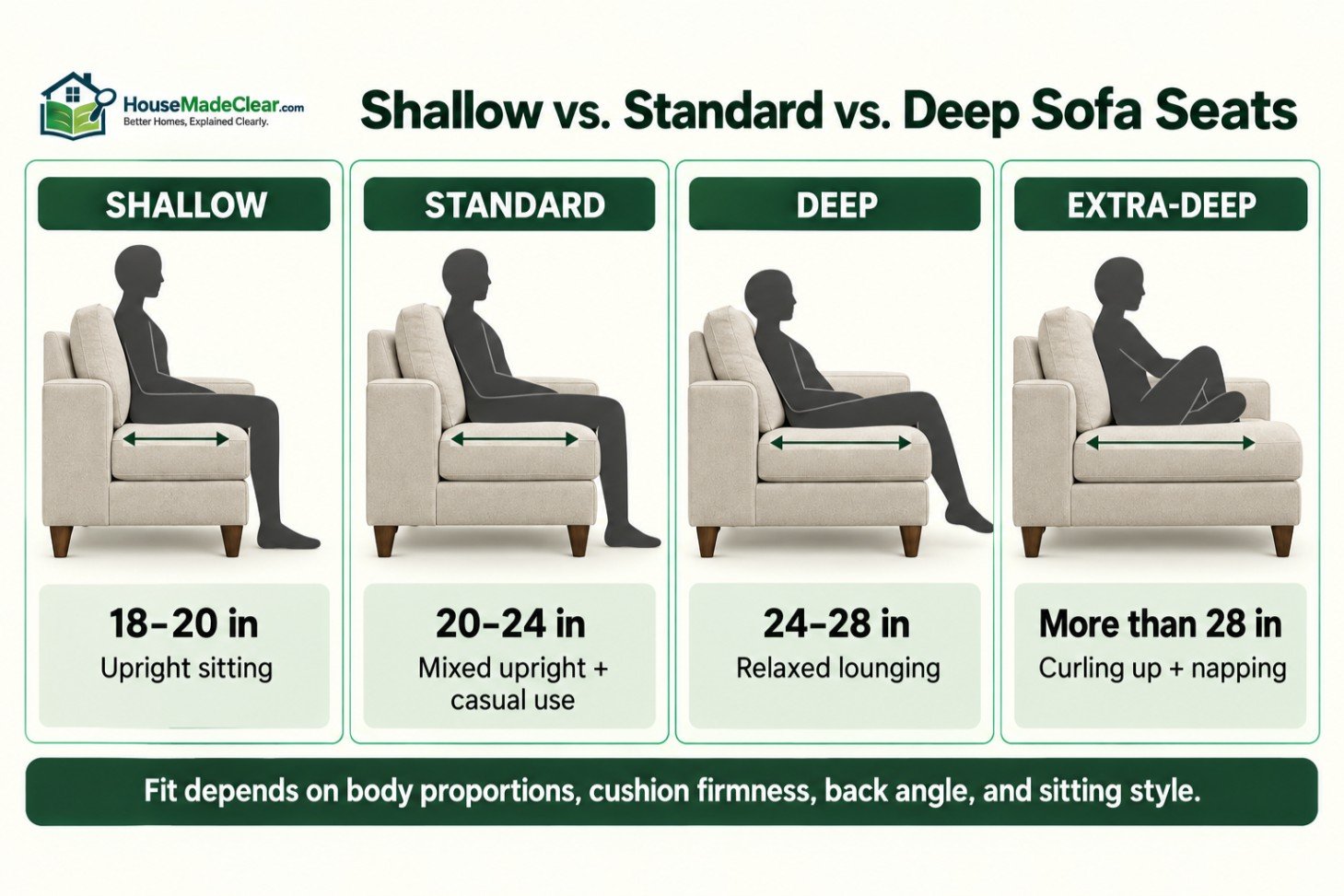
Shallow vs. Standard vs. Deep Sofa Seats
| Seat Type | Approximate Seat Depth | Typical Sitting Style |
|---|---|---|
| Shallow | 18–20 inches | Upright sitting and conversation |
| Standard | 20–24 inches | Mixed upright sitting and casual lounging |
| Deep | 24–28 inches | Relaxed lounging and tucked-leg sitting |
| Extra deep | More than 28 inches | Napping, curling up and bed-like lounging |
These ranges are useful for comparison, not strict product classifications.
Shallow Seats
A shallow sofa seat can help users sit with:
- Their back against the cushion
- Feet resting on the floor
- Knees near a natural angle
- Less effort when standing
Shallow seats often suit:
- Shorter adults
- Older users
- Formal living rooms
- Conversation spaces
- Waiting areas
- People who prefer firm, upright support
A seat that is too shallow can feel restrictive for taller users and uncomfortable for lounging.
Standard Seats
A standard seat offers a compromise between upright support and relaxation.
It is often the safest choice for:
- Mixed-height households
- Multipurpose living rooms
- Guests
- Reading
- Television viewing
- Everyday family use
Removable pillows can make the seat temporarily shallower for smaller users.
Deep Seats
A deep seat allows users to:
- Lean back
- Curl up
- Sit cross-legged
- Stretch out
- Nap
- Share the sofa with children or pets
It may be uncomfortable for someone whose feet cannot touch the floor while their back remains supported.
Extra-Deep Seats
Extra-deep seats work more like lounge platforms than conventional upright chairs.
They can be excellent for movie rooms and relaxed family spaces but poor for formal conversation, older users or anyone who needs firm support when standing.
How User Height Affects Sofa Seat Depth
There is no accurate universal table that assigns a seat depth to a person’s height. Body proportions differ, and sitting style matters as much as total height.
Use these tendencies as starting points:
Shorter Users
Shorter users often prefer a shallower seat because it lets them use the backrest without leaving their feet unsupported.
Signs that the seat is too deep include:
- Feet do not reach the floor
- User slides forward
- Lower back loses contact with the back cushion
- Extra pillows are always required
- Pressure develops behind the knees
- Standing requires excessive forward movement
Average-Height Users
A seat depth around 20 to 24 inches works for many adults, but cushion firmness and back angle still matter.
Testing the couch is more reliable than selecting from a generic chart.
Taller Users
Taller users may prefer a deeper seat because it supports more of the thighs and provides room to relax.
A shallow couch can make a tall user feel as if they are perched on the front edge.
However, a tall person who prefers upright seating may still choose a standard rather than deep seat.
Mixed-Height Households
For households with users of different heights, consider:
- A standard-depth couch
- Removable back cushions
- Lumbar pillows
- Adjustable headrests
- A chaise for deeper lounging
- A mix of sofa and chairs
- Modular seats with different depths
Do not choose an extra-deep couch solely for the tallest person if everyone else will struggle to use it.
How to Tell Whether a Couch Seat Fits
Sit naturally with your hips and back against the back cushion.
A well-fitting upright seat generally allows:
- Back support without slouching forward
- Feet to rest comfortably
- No excessive pressure behind the knees
- Comfortable thigh support
- Easy standing
- A natural position without extra pillows
Cornell University’s ergonomics guidance on sitting explains the general seating principle: when a seat is deeper than the user’s buttock-to-knee length, the user may be unable to use the backrest properly.
Office-chair measurements should not be copied directly to sofas because sofa cushions, recline angles and use patterns differ. The underlying fit problem is still relevant: a seat can be too deep for a specific user even when its dimensions fall within a normal sofa range.
Quick Fit Test
While sitting against the back cushion:
- Check whether your feet rest comfortably.
- Check for pressure behind your knees.
- Reach the armrests without shifting excessively.
- Sit for at least several minutes.
- Try standing without pulling on nearby furniture.
- Test both upright and relaxed positions.
- Add or remove the pillows you expect to use at home.
A couch that feels soft for 30 seconds may become unsupportive after several minutes.
Upright Sitting vs. Lounging
The right seat depth depends heavily on how the couch will be used.
Conversation and Formal Sitting
Choose a shallow or standard seat when the room is mainly used for:
- Conversation
- Entertaining guests
- Reading upright
- Short visits
- Formal seating
- Easy sitting and standing
A seat around 20 to 22 inches often supports this purpose better than an extra-deep cushion.
Television and Family Rooms
A standard or moderately deep seat works well when the room supports:
- Television viewing
- Family gatherings
- Casual reading
- Gaming
- Children and pets
- Occasional napping
A 22- to 25-inch seat may provide useful flexibility, depending on the users.
Movie Rooms and Lounging
A deeper seat may be appropriate when users mainly:
- Recline
- Curl up
- Stretch out
- Sit cross-legged
- Watch long movies
- Nap
Depths of approximately 24 to 28 inches are common in lounge-oriented designs.
Eating or Working on the Sofa
An extra-deep, soft couch is usually a poor surface for upright eating or laptop work. It places the user farther from the table and can encourage slouched posture.
If the sofa is regularly used with a lift-top coffee table, test the complete seated relationship rather than choosing both pieces separately.
Cushion Construction Changes Usable Depth
The advertised seat depth may not match the space available during use.
Loose Back Cushions
Loose cushions can project forward and reduce seat depth. Overfilled cushions may remove several inches from the usable seat.
Attached Back Cushions
Attached cushions provide a more consistent measurement, but their shape can still push the user forward.
Lumbar Pillows
Lumbar and throw pillows can convert a deep sofa into a more supportive seat for shorter users.
Measure the couch:
- Without additional pillows
- With standard back cushions
- With the pillows you expect to use
Soft Seat Cushions
Soft cushions compress and allow the user to sink lower and farther back.
This can make the couch feel deeper than its stated measurement.
Firm Seat Cushions
A firm cushion keeps the user higher and makes it easier to change position or stand.
A firm 24-inch seat may feel more upright than a very soft 22-inch seat.
Sloped Backrests
A reclined back angle can increase the relaxed feeling even when seat depth is moderate.
Depth, cushion firmness and back angle must be judged together.
How to Measure Overall Couch Depth
Use a rigid tape measure and record measurements in inches.
Step 1: Identify the Rearmost Point
Find the farthest point at the back of the couch. This may be:
- Rear frame
- Back cushion
- Upholstered curve
- Headrest
- Recliner mechanism
- Decorative trim
Step 2: Identify the Frontmost Point
Find the farthest point at the front. This may be:
- Seat cushion
- Front rail
- Recliner footrest when closed
- Projecting leg
- Curved arm
- Upholstered base
Step 3: Measure Horizontally
Measure straight from the rear point to the front point.
Do not follow the angle of a sloped backrest. Overall depth describes the horizontal floor footprint.
Step 4: Add Required Wall Clearance
Some couches can sit close to the wall. Others require space for:
- Reclining mechanisms
- Electrical connections
- Ventilation
- Curtains
- Baseboard heaters
- Floor or wall vents
- Cleaning
- Moving cushions
Follow the manufacturer’s placement instructions.
How to Measure Sofa Seat Depth
Seat depth is measured from the front edge of the usable cushion to the point where the user’s back contacts the rear cushion or inside back.
With Back Cushions Installed
This is the most useful everyday measurement.
Arrange the couch normally, then measure from:
- Front center of seat cushion
- Straight back to the front face of the back cushion
Without Back Cushions
This measurement reveals the couch’s maximum inside depth, but it may not represent normal use.
Record it separately when the cushions are removable.
With Lumbar Pillows
Measure again if lumbar or decorative pillows will remain in place. This provides the effective supported seat depth.
Measure More Than One Position
Sectionals and modular couches can contain:
- Standard seats
- Corner seats
- Chaise seats
- Reclining seats
- Armless modules
- Wedge modules
Measure every distinct seating position.
Overall Depth and Room Planning
A couch must fit the room before its seat depth can matter.
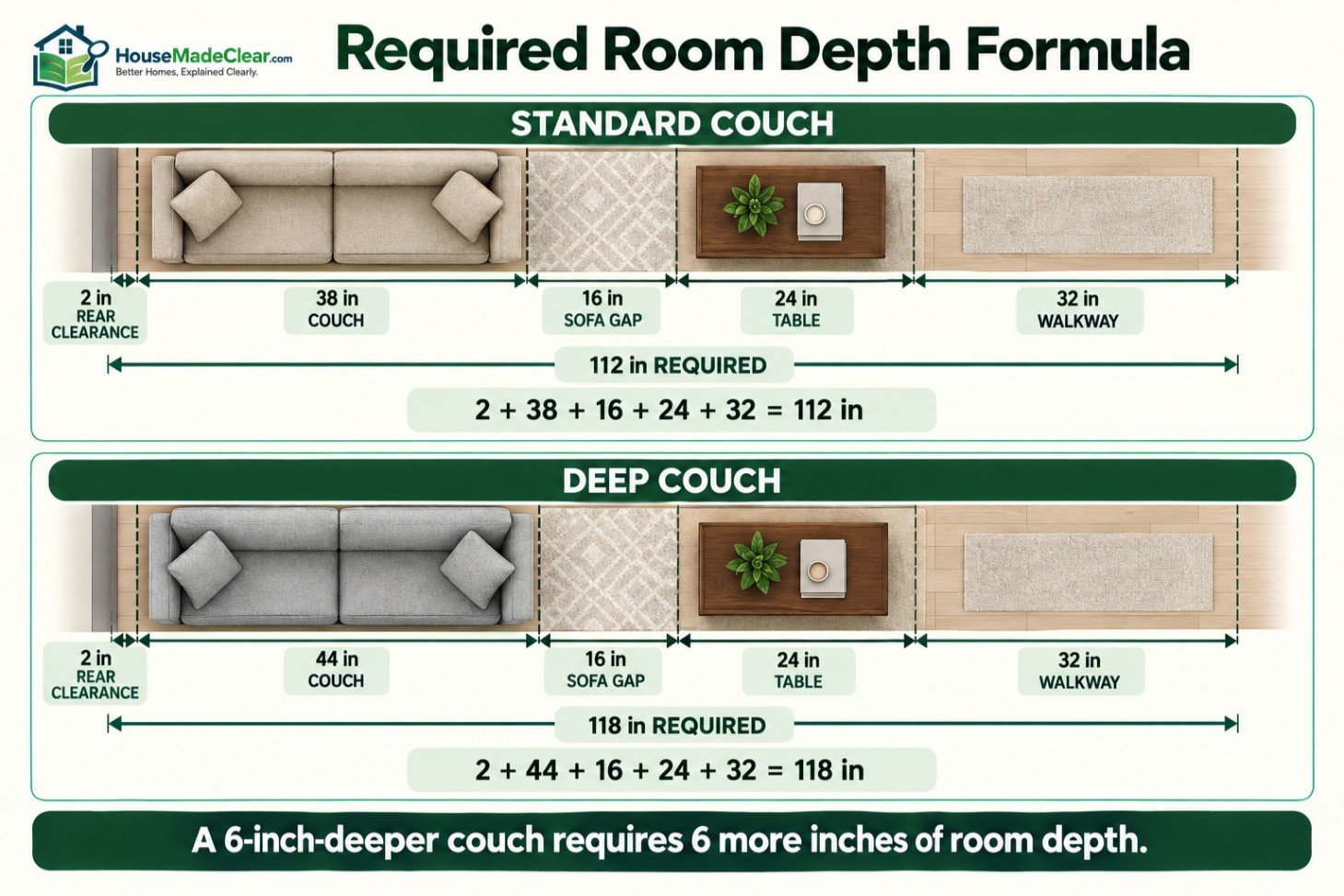
Use this basic formula:
Required room depth = rear clearance + couch depth + sofa-to-table gap + coffee table width + opposite clearance
Suppose the layout includes:
- Rear wall clearance: 2 inches
- Couch depth: 38 inches
- Sofa-to-table gap: 16 inches
- Coffee table width: 24 inches
- Walkway beyond table: 32 inches
Required depth:
2 + 38 + 16 + 24 + 32 = 112 inches
The layout requires approximately 112 inches, or 9 feet 4 inches, from the wall behind the couch to the opposite furniture or circulation boundary.
A 44-inch-deep couch would increase the requirement to:
2 + 44 + 16 + 24 + 32 = 118 inches
That 6-inch difference may be enough to restrict a walkway.
Use our guide to the distance between a sofa and coffee table when calculating the full seating zone.
Couch Depth Calculation Examples
Example 1: Standard Couch in a Medium Room
Assume:
- Wall to TV console: 126 inches
- Couch depth: 38 inches
- Rear clearance: 2 inches
- Coffee table gap: 16 inches
- Coffee table width: 24 inches
Remaining space between the table and console:
126 − 2 − 38 − 16 − 24 = 46 inches
The layout provides a generous 46-inch passage.
Example 2: Deep Couch in the Same Room
Replace the 38-inch couch with a 45-inch-deep model:
126 − 2 − 45 − 16 − 24 = 39 inches
The deep couch still fits, but it reduces the passage by 7 inches.
Example 3: Compact Living Room
Assume:
- Wall to opposite cabinet: 96 inches
- Couch depth: 40 inches
- Rear clearance: 1 inch
- Coffee table gap: 14 inches
- Coffee table width: 20 inches
Remaining clearance:
96 − 1 − 40 − 14 − 20 = 21 inches
The furniture fits physically, but the 21-inch space beyond the table is not a comfortable main walkway.
Possible solutions include:
- Choosing a 34-inch-deep couch
- Using a narrower coffee table
- Replacing the coffee table with nesting tables
- Reorienting the layout
- Removing the central table
Example 4: Compact Couch Alternative
Using a 33-inch couch in the same room:
96 − 1 − 33 − 14 − 20 = 28 inches
The compact couch recovers 7 inches of circulation space.
Choosing Couch Depth for a Small Living Room
In a small room, overall depth matters more than the “apartment sofa” label.
Some apartment sofas are narrow but still 40 inches deep. They save wall width without improving the front-to-back layout.
For a compact room, prioritize:
- Overall depth around 28 to 35 inches
- Seat depth suited to regular users
- Thin or track arms
- Modest back cushions
- Raised legs that expose more floor
- No unnecessary rear projections
- Appropriate coffee-table clearance
- Clear entry and walking routes
Use painter’s tape to mark the full couch footprint before ordering.
A compact couch should not be so shallow that it becomes uncomfortable. Saving 3 inches is pointless if the seat does not suit the household.
Choosing Couch Depth for a Large Living Room
A large room can accommodate deeper seating, but depth should still serve a purpose.
A deep couch may help:
- Define a large seating zone
- Balance high ceilings
- Support family lounging
- Fill an open-plan room
- Create a substantial visual anchor
Do not push the couch against a distant wall merely because space is available. A large room may function better with a floating seating arrangement and circulation behind the sofa.
Our guide to planning a functional living room layout explains how to organize furniture around focal points and walking routes.
Couch Depth for a Sectional
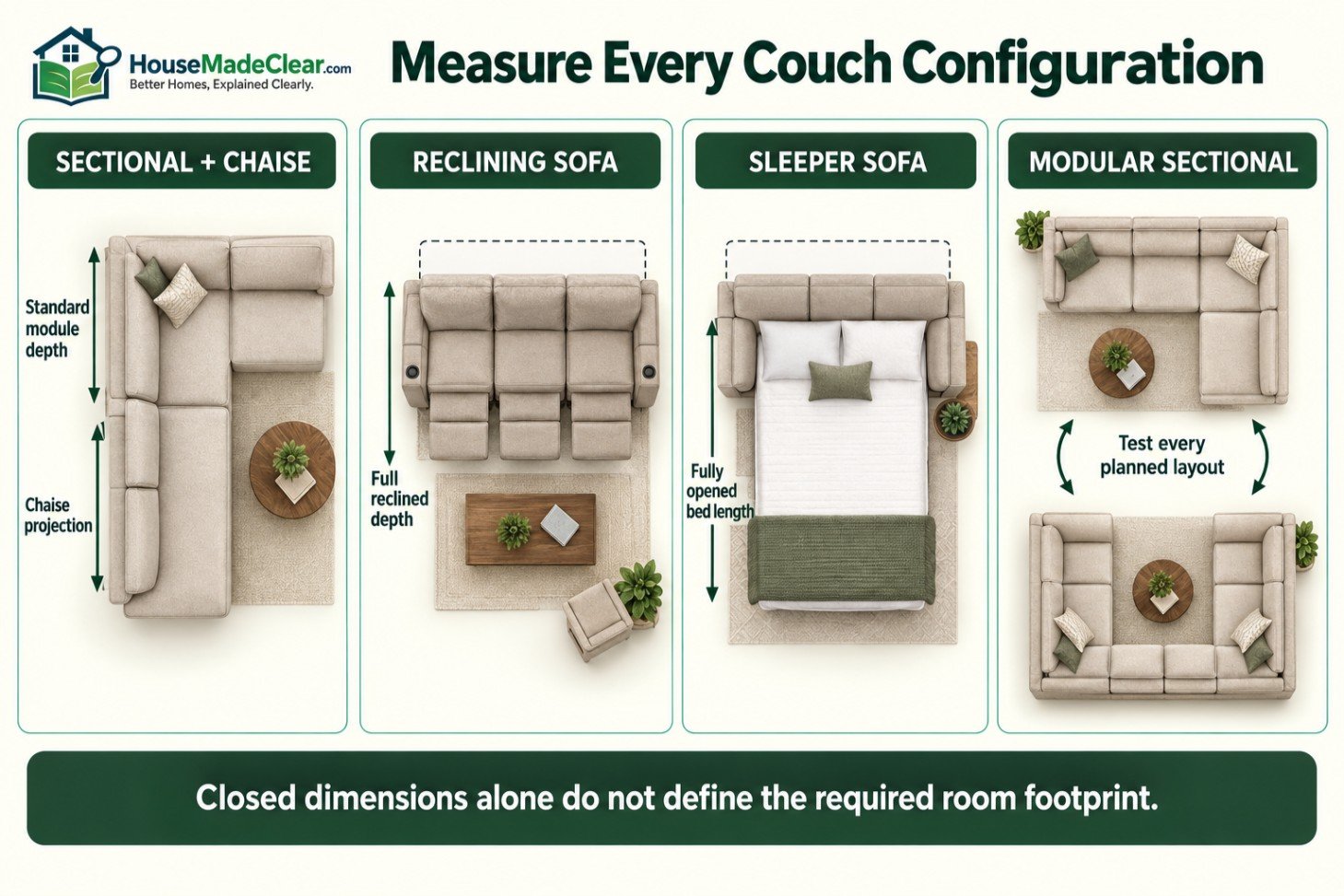
Sectional depth must be measured in several directions.
Record:
- Standard module depth
- Corner-module depth
- Chaise length
- Recliner extension
- Overall sectional projection
- Interior seating opening
- Distance from wall to front edge
A sectional may be 40 inches deep along the sofa portion but project 65 to 75 inches at the chaise.
Do not record only the primary sofa depth. The chaise or return section often controls the room layout.
L-Shaped Sectional
Measure both legs of the L and the standard module depth.
Check whether the return blocks:
- Doorways
- Windows
- Walkways
- Heating and cooling equipment
- Coffee-table access
U-Shaped Sectional
Measure the outer footprint and the interior opening.
A U-shaped sectional with deep seats may leave insufficient space for a coffee table or entry into the seating area.
Modular Sectional
Measure every module and test all intended configurations. A layout that works as an L may become too deep when rearranged into a chaise or U shape.
Couch Depth for a Reclining Sofa
A reclining sofa has at least two depths:
- Closed depth
- Fully reclined depth
Some models also require rear wall clearance, while wall-hugger designs move forward as they recline.
Verify:
- Closed overall depth
- Full extension
- Rear clearance
- Footrest projection
- Headrest movement
- Power-cord location
- Clearance from coffee table
- Clearance from opposite furniture
Do not plan a reclining sofa from its closed dimensions alone.
Open every seat simultaneously when measuring a multi-seat recliner. A room that accommodates one extended footrest may not support the entire sofa in use.
Couch Depth for a Sleeper Sofa
A sleeper sofa must fit in both sofa and bed configurations.
Record:
- Closed couch depth
- Fully opened bed length
- Space required to pull out the mechanism
- Walking space beside the bed
- Clearance to walls and furniture
- Coffee-table storage location
The coffee table may need to be moved every time the bed opens. Make sure it can be moved safely and stored without blocking the door.
Sleeper mechanisms also add weight. Delivery planning is particularly important.
Couch Depth for a Sofa With Chaise
A chaise is substantially deeper than the standard sofa seat.
Measure:
- Chaise projection from rear to front
- Usable cushion length
- Width of chaise module
- Space beside chaise
- Coffee-table relationship
- Walking route around the end
Do not place the chaise where it cuts across the room’s main path.
A reversible chaise provides layout flexibility, but only if both possible positions have been measured.
Couch Depth and Coffee Table Placement
A deeper couch can change the ideal coffee-table relationship.
Someone sitting against the back of a deep seat may be farther from the table even when the floor gap is correct.
Possible solutions include:
- Reducing the sofa-to-table gap
- Choosing a wider table
- Using nesting tables
- Adding side tables
- Using pull-up C-tables
- Providing an ottoman tray
Do not reduce the gap so far that standing becomes difficult.
The table’s height also affects reach. Compare the seat and tabletop using our standard coffee table height guide.
Couch Depth and Delivery Access
A couch that fits the room may not fit through the delivery route.
Measure:
- Exterior door
- Interior doors
- Hallway width
- Hallway turns
- Stair width
- Stair landings
- Ceiling height
- Elevator doors
- Elevator interior
- Room entrance
- Removable legs
- Removable cushions
- Diagonal couch depth
Crate & Barrel’s furniture-delivery guide recommends checking product height, width and diagonal depth, then measuring every doorway, elevator and turn along the delivery route.
Straight Doorway
Compare the doorway with:
- Couch height
- Couch depth
- Diagonal depth
Removal of legs may reduce height, but only if the manufacturer confirms that they are removable.
Hallway Turn
Measure both hallway sections and the diagonal clearance through the corner.
A couch may pass through each hallway individually but fail at the turn.
Stairway
Check:
- Stair width
- Railing projections
- Ceiling height
- Landing depth
- Top and bottom turns
- Light fixtures
- Sloped ceilings
Do not assume professional delivery guarantees that every couch can reach the intended room.
How to Compare Couch Depth When Shopping Online
Product pages often place measurements in different sections.
Look for:
- Overall depth
- Seat depth
- Inside depth
- Seat height
- Back cushion thickness
- Reclined depth
- Chaise depth
- Sleeper dimensions
- Diagonal depth
- Minimum door width
- Removable components
If seat depth is missing, ask the retailer or manufacturer for the measurement with the back cushions installed.
Do not calculate usable seat depth by subtracting estimated cushion thickness from overall depth. Frame construction may make that calculation inaccurate.
How to Test Couch Depth Before Buying
Measure a Couch You Already Know
Measure an existing sofa or chair that feels comfortable.
Record:
- Overall depth
- Seat depth
- Seat height
- Back angle
- Cushion firmness
Use those measurements as a comparison.
Test the Couch Normally
Sit as you would at home:
- Upright
- Reclined
- With feet on the floor
- With legs tucked up
- With a pillow
- Without extra pillows
Remain seated long enough to notice pressure or lack of support.
Test Standing Up
A couch may feel comfortable while sitting but be difficult to leave.
Check whether you can stand without:
- Pulling on the arms
- Rocking repeatedly
- Sliding far forward
- Using the coffee table for support
Test Every Regular User
The person purchasing the couch should not be the only tester.
Consider:
- Shortest regular user
- Tallest regular user
- Older adults
- Children
- Anyone with limited mobility
- Anyone who uses the sofa for work or sleeping
Mock Up the Room Footprint
Mark the overall couch depth on the floor with painter’s tape.
Add:
- Rear clearance
- Coffee-table gap
- Table footprint
- Recliner extension
- Chaise projection
- Main walkway
Live with the outline for part of a normal day before ordering.
Common Couch-Depth Mistakes
Confusing Overall Depth With Seat Depth
Overall depth determines room fit. Seat depth determines much of the sitting experience. You need both measurements.
Buying a Deep Couch Because It Looks Comfortable
A deep sofa can be uncomfortable for shorter users or anyone who prefers upright support.
Assuming an Apartment Sofa Is Shallow
“Apartment” often refers to width, not depth.
Ignoring Back Cushions
Thick cushions can reduce usable seat depth substantially.
Measuring Only the Closed Recliner
The fully opened position determines whether the room can support the sofa.
Ignoring the Chaise
The chaise is commonly the sectional’s deepest component and may block circulation.
Forgetting the Coffee Table
A deep couch plus a full-width coffee table can eliminate the remaining walkway.
Buying for One User
A couch shared by a household should accommodate more than the person who selected it.
Skipping the Delivery Route
Overall and diagonal depth can prevent the couch from passing through a doorway or turn.
Using the Product Photograph as Scale
Wide-angle photography and large showrooms can make deep couches appear smaller than they are.
Measuring the Room Without Baseboards or Trim
The narrowest finished dimension controls the fit.
Treating Softness as Support
A soft couch may feel inviting initially but allow the user to sink too deeply for comfortable movement.
Couch Depth Checklist
| Measurement or Detail | What to Verify |
|---|---|
| Overall depth | Farthest rear point to farthest front point |
| Seat depth | Front cushion edge to normal back-support point |
| Effective seat depth | Measure with cushions and pillows installed |
| Diagonal depth | Verify for doorways and delivery turns |
| Rear clearance | Follow manufacturer requirements |
| Cushion firmness | Test how far the user sinks |
| Back angle | Compare upright and relaxed positions |
| User fit | Back supported, feet comfortable and no knee pressure |
| Room depth | Include couch, table and walkways |
| Coffee-table gap | Coordinate with seated reach |
| Sectional projection | Measure every module and chaise |
| Reclined depth | Open every moving seat |
| Sleeper footprint | Measure the fully extended bed |
| Doorways | Use the narrowest finished opening |
| Hallway turns | Check diagonal rotation space |
| Stairways | Measure width, landing and ceiling clearance |
| Elevator | Check door and interior dimensions |
| Removable parts | Confirm with the manufacturer |
| Floor mockup | Mark all closed and open positions |
| Product specification | Do not rely on category names alone |
Final Recommendation
For most living rooms, begin with an overall couch depth of approximately 35 to 40 inches and a usable seat depth of approximately 20 to 24 inches.
Choose toward the shallower end when:
- The room is compact
- Users prefer upright sitting
- Shorter adults use the sofa
- Easy standing is important
- The sofa sits along a busy walkway
Choose a deeper couch when:
- The room has sufficient floor space
- Lounging is the primary use
- Taller users need more thigh support
- Users sit cross-legged or curl up
- The sofa serves a media or family room
Measure overall depth for the room and seat depth for the user. Then check cushions, back angle, coffee-table placement, moving mechanisms and the complete delivery route.
A couch is not correctly sized merely because it fits against the wall. It must fit the people, circulation and everyday use of the room.
Frequently Asked Questions
What is the standard depth of a couch?
The standard overall couch depth is commonly approximately 35 to 40 inches. Compact sofas may be shallower, while deep lounging sofas can measure 40 to 45 inches or more.
What is the standard seat depth of a sofa?
A standard sofa seat depth is generally around 20 to 24 inches. Seats around 20 to 22 inches tend to feel more upright, while depths closer to 23 or 24 inches feel more relaxed.
What is the difference between couch depth and seat depth?
Couch depth measures the complete furniture footprint from front to back. Seat depth measures only the usable sitting area from the front edge of the cushion to the inside back cushion.
Is a 40-inch-deep couch too deep?
A 40-inch overall depth is near the upper end of the common standard range. It can work well in many living rooms, but the usable seat depth and remaining circulation space must also be checked.
What is considered a deep-seat sofa?
A seat depth greater than approximately 23 or 24 inches is commonly considered deep. Some manufacturers use 25 inches or more as the starting point for deep seating.
Is a deeper sofa more comfortable?
Not automatically. A deeper sofa can be comfortable for lounging and taller users but uncomfortable for shorter users or anyone who prefers to sit upright with their feet on the floor.
What couch depth is best for a small living room?
An overall depth of approximately 28 to 35 inches can help preserve space in a small room. Verify the usable seat depth because a compact overall frame can still provide a comfortable seat.
How do I measure sofa seat depth?
Measure horizontally from the front edge of the seat cushion to the point where your back normally rests against the inside back cushion. Keep the usual back cushions installed.
How much room does a deep couch need?
Add the couch’s overall depth to its rear clearance, coffee-table gap, table width and the required walkway beyond the table. A 45-inch couch may require 7 to 10 inches more room depth than a compact model.
Does sofa depth affect delivery?
Yes. Overall depth, height and diagonal depth determine whether the couch can pass through doors, hallways, elevators and stair turns. Measure the complete delivery route before ordering.







[…] Standard Couch Depth: Overall and Seat Depth Guide […]
[…] Standard Couch Depth: Overall and Seat Depth Guide […]
[…] Standard Couch Depth: Overall and Seat Depth Guide […]