












A home does not become secure simply because it has a camera, an alarm or an expensive lock. Many properties remain vulnerable because basic entry points are weak, security equipment is poorly positioned, access permissions are not reviewed and everyday precautions are used inconsistently.
Effective home security usually begins with the less dramatic details: doors that close correctly, windows that are actually locked, exterior areas that remain visible and household members who follow the same security routine.
HouseMadeClear approaches home security as part of the whole home rather than as a collection of separate devices. This guide draws on practical home-security principles and the combined interior-design and security perspective explained on the Meet Charu page.
Quick answer:
The most common home security mistakes include relying on a lock without checking the door and frame, hiding spare keys outside, overlooking side and rear entrances, depending on cameras instead of physical security, using poor exterior lighting, sharing access codes carelessly and failing to test security equipment. The best place to start is usually with doors, accessible windows and any key or code that may already be compromised.
Why Small Home Security Mistakes Matter
A break-in does not always require sophisticated planning. A poorly secured window, damaged frame, unlocked side door or hidden spare key may provide an easier opportunity than attacking the most visible entrance.
Research reviewed by the UK College of Policing indicates that window locks, external lighting and door locks can provide meaningful benefits as individual security measures. Combining multiple measures generally provides more protection than relying on one device alone.
That does not mean every home needs an expensive system. It means physical security, visibility, detection, access control and household habits should support one another.
The following mistakes are worth checking in houses, apartments and rental properties.
1. Assuming a Good Lock Makes the Entire Door Secure
A high-quality lock cannot compensate for a weak door, damaged frame or poorly secured strike plate.
Homeowners sometimes focus entirely on the visible lock while overlooking:
- Cracked or deteriorated door frames
- Loose hinges
- Weak surrounding material
- Gaps that prevent the bolt from engaging properly
- A strike plate that moves under pressure
- Decorative doors that are unsuitable for exterior use
- Poor alignment caused by movement, moisture or age
The door, frame, hinges, lock and installation should be treated as one system. A failure in any one of these components can reduce the effectiveness of the others.
How to Correct It
Close and lock the door, then check whether it moves excessively inside the frame. Look for loose hardware, visible cracks, alignment problems and a bolt that does not fully enter the frame.
Do not attempt structural repairs or security modifications beyond your experience. A qualified locksmith, carpenter or door installer can assess whether the weakness is in the lock, frame, door construction or installation.
Charu’s Practical Perspective
Security hardware should not be selected only by appearance. A lock may look substantial while the surrounding door assembly remains weak. Interior and exterior design decisions should therefore account for how the complete entrance will function, not merely how the handle and lock will look.
2. Continuing to Use a Worn, Damaged or Compromised Lock
Locks and doors change over time. Hinges loosen, frames shift, cylinders wear and latches may stop aligning correctly.
Warning signs include:
- A key that sticks or requires force
- A loose cylinder or handle
- A deadbolt that does not extend fully
- A latch that misses the strike plate
- Visible corrosion
- A lock that has been damaged during an attempted entry
- Missing keys that were never accounted for
A lock should also be reviewed after a tenant, employee, contractor, cleaner or former household member no longer requires access.
What to Check
Inspect whether:
- The door closes without lifting, pushing or pulling it into place
- The lock engages smoothly
- The bolt enters the frame completely
- Exterior hardware is secure
- All keys are accounted for
- Former users still have physical or digital access
- The product remains appropriate for the door type
Do not assume a smart lock is automatically safer than a traditional lock. Installation quality, door construction, access management, certification and maintenance matter more than whether the lock connects to an app.
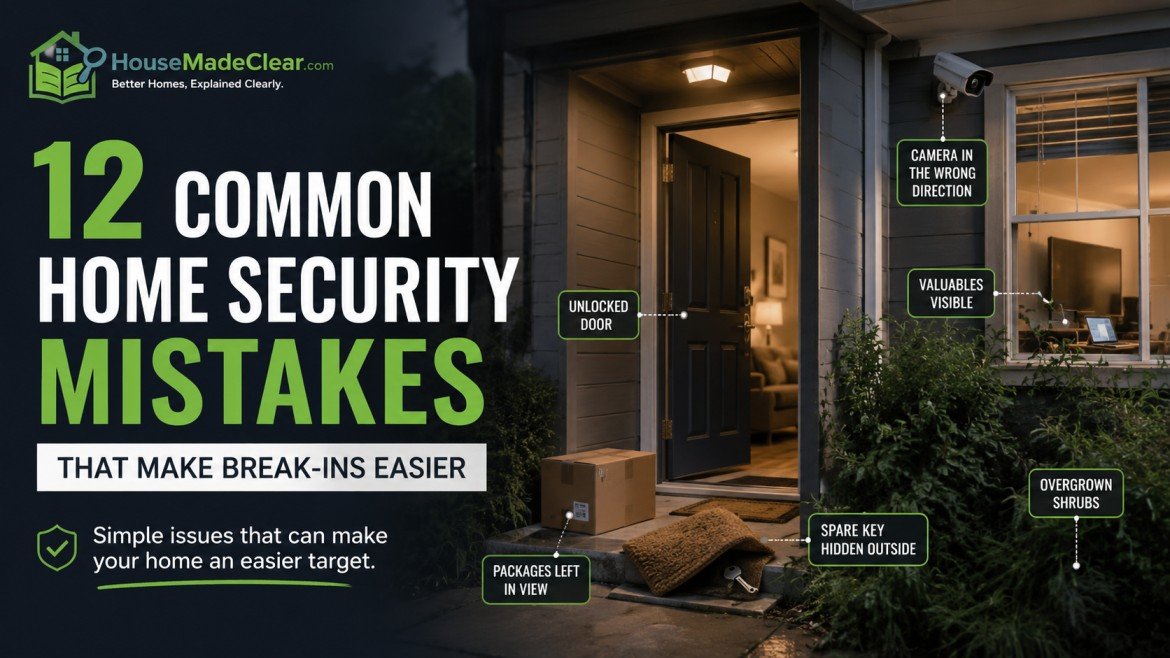
3. Hiding a Spare Key Outside
A spare key placed close to the entrance is convenient for the homeowner, but it may also be convenient for someone looking for a quick way inside.
Common hiding places include:
- Under a doormat
- Inside a plant pot
- Above the door frame
- In a meter or utility box
- Beneath a decorative object
- Inside an obvious fake rock
- Near a garage or shed
The problem is not only whether a particular hiding place is “clever.” It is that the key may remain outside for months without anyone checking whether it has been found, copied or moved.
Safer Alternatives
Consider:
- Leaving a spare key with a trusted person
- Using a properly selected and securely installed key safe
- Using temporary access codes where the system supports them
- Creating separate codes for household members and service providers
- Removing access when it is no longer needed
- Replacing or rekeying locks when a key cannot be accounted for
A cheap or poorly installed lockbox can itself become a weak point. Choose its position and security level carefully rather than simply attaching it beside the main door.
4. Securing the Front Door but Ignoring Other Entry Points
The front entrance receives the most attention because it is used every day. Side doors, patio doors, garage entrances, basement windows and balcony access may receive much less scrutiny.
Commonly overlooked entry points include:
- Ground-floor windows
- Windows above a low roof or extension
- Sliding patio doors
- French doors
- Side gates
- Doors between an attached garage and the home
- Basement or utility entrances
- Balcony doors
- Pet doors
- Outbuildings containing tools or ladders
Official police guidance repeatedly advises residents to close and lock doors and windows whenever they leave, even for a short time. It also warns against leaving keys where they can be reached through a letterbox, pet door or nearby opening.
Conduct an Entry-Point Audit
Walk around the outside of the property and list every realistic way someone could approach or enter.
For each point, check:
- Does it close correctly?
- Does it lock?
- Is the frame in good condition?
- Can it be seen from the home, street or neighbouring property?
- Is it hidden by a wall, fence, vehicle or vegetation?
- Is there a low structure that makes an upper window accessible?
- Does exterior lighting cover the area?
- Would the household notice if it were opened?
For sliding patio doors, check whether the system can resist being lifted or forced from its track. Secured by Design specifically advises checking for anti-lift protection on vulnerable sliding doors.
Note for Renters
Renters should report defective locks, frames and windows to the landlord or property manager promptly. Do not drill, replace permanent hardware or modify shared entrances without the required permission.
Document the problem in writing and retain photographs when a repair request concerns a significant security weakness.
5. Depending on Cameras Instead of Physical Security
A security camera can help detect, record or discourage activity. It does not physically reinforce a door, repair a window or stop someone from using a compromised key.
Cameras may be useful for:
- Monitoring approach routes
- Receiving motion notifications
- Checking deliveries
- Documenting an incident
- Viewing an entrance remotely
- Supporting other security measures
However, a camera should not create false confidence while basic entry points remain weak.
Use Layers Instead of One Device
A practical sequence is:
- Make sure doors and windows close and lock correctly.
- Correct visible physical weaknesses.
- Improve lighting and visibility.
- Add sensors, alarms or alerts where useful.
- Position cameras around relevant approach routes and entrances.
- Establish a response plan for notifications and alarms.
- Test and maintain every layer.
Technology is most useful when it strengthens an existing security plan rather than replacing one.
6. Installing Cameras in the Wrong Locations
A camera can be working perfectly while recording very little useful information.
Common placement problems include:
- Mounting the camera too high
- Pointing it mainly at the ground or sky
- Leaving an important approach route outside the frame
- Positioning it behind plants or decorations
- Allowing bright lights to create glare
- Ignoring side and rear entrances
- Using a location with poor Wi-Fi
- Failing to test the nighttime image
- Capturing a person only after they have reached the door
- Recording more neighbouring or public space than necessary
What a Home Camera Should Capture
Depending on the property and local law, a camera may be more useful when it covers:
- The route leading to an entrance
- The entrance itself
- A person’s face at a usable angle
- A gate or driveway
- A package-delivery area
- A side passage
- A garage or outbuilding entrance
Test the live view during daylight, after dark and in poor weather. A position that looks clear in the afternoon may become unusable when a porch light, vehicle headlight or infrared reflection enters the frame.
UK Privacy Consideration
In the UK, a domestic CCTV system or video doorbell may fall within data-protection requirements when it records beyond the user’s property boundary, such as a neighbour’s property, a shared area or the street. The Information Commissioner’s Office advises householders to consider what is being captured and why, and provides specific guidance for domestic CCTV users.
Aim cameras at the area reasonably needed to protect the property rather than recording a wider area simply because the equipment allows it.
7. Using Exterior Lighting Poorly
Dark entrances and side passages may reduce visibility. But excessively bright or badly positioned lighting can create glare, strong shadows and poor camera images.
Common lighting mistakes include:
- Leaving a side or rear entrance completely dark
- Using one bright fixture that does not cover the approach route
- Pointing light directly into a camera
- Allowing plants to block the fixture
- Installing motion lighting that triggers constantly
- Ignoring paths, gates and garage entrances
- Failing to replace broken bulbs
- Using lighting that can easily be reached and disabled
Secured by Design recommends external lighting at entrances and exits and notes that poorly adjusted motion-activated lighting may trigger unnecessarily.
How to Improve Security Lighting
Use lighting to make movement and entrances visible without creating unnecessary nuisance for occupants or neighbours.
Check whether:
- Faces can be seen near the entrance
- Steps and paths are visible
- Lighting supports the camera image
- Important fixtures are difficult to tamper with
- Motion sensors are adjusted appropriately
- The light causes glare through windows
- The fixture unnecessarily illuminates neighbouring property
Lighting should support safe movement, natural visibility and security. It should not turn the exterior into an uncomfortable floodlit area.
8. Allowing Landscaping and Outdoor Items to Create Concealment or Access
Landscaping can provide privacy and improve the appearance of a property. Poorly planned landscaping can also hide doors, windows and side passages.
Potential problems include:
- Tall shrubs directly beside accessible windows
- Dense planting around an entrance
- A side gate hidden from view
- Trees or structures that provide access to upper levels
- Ladders left unsecured
- Bins or furniture that can be climbed
- Overgrown plants blocking lights or cameras
- High solid barriers that hide activity near the home
The answer is not to remove every plant or eliminate privacy. The goal is to prevent the most vulnerable entry points from becoming completely concealed.
Balance Privacy With Visibility
Consider:
- Keeping lower planting near entrances trimmed
- Ensuring lights and cameras remain unobstructed
- Securing ladders and tools
- Avoiding climbable items beneath accessible windows
- Checking whether gates can be seen and secured
- Using layered planting that provides privacy without creating a hidden enclosure
This is where home design and security often overlap. A visually attractive entrance should still allow residents to see who is approaching and notice unusual activity.
9. Making It Obvious That the Home Is Empty
A prolonged absence can become visible through accumulated deliveries, unchanged lighting, open curtains or public social-media activity.
Signs may include:
- Packages or mail left outside
- Bins never moved
- A driveway remaining empty
- Lights staying off for several evenings
- Curtains remaining in exactly the same position
- Maintenance being ignored
- Travel plans posted publicly in real time
- Regular household activity suddenly stopping
Police guidance recommends establishing an exit routine, securing doors and windows, keeping valuables out of sight and considering lighting when the home will be empty after dark.
Reduce Obvious Signs of Absence
Before travelling:
- Pause or redirect deliveries
- Ask a trusted person to check the property
- Arrange mail and bins
- Lock all accessible doors and windows
- Review alarm and camera notifications
- Use suitable lighting schedules
- Avoid publishing real-time travel details publicly
- Confirm that emergency contacts are current
- Check that water, electrical and heating arrangements are safe
Do not create the appearance of occupancy using unsafe electrical practices or equipment that is not designed for scheduled operation.
10. Sharing Access Codes and Smart-Home Permissions Carelessly
Modern access is not limited to physical keys. Smart locks, camera systems, alarms and home-automation platforms may provide access through codes, applications and shared accounts.
Common mistakes include:
- Reusing one code for everyone
- Giving contractors permanent access
- Sharing the main account password
- Leaving former residents on the account
- Using the manufacturer’s default password
- Failing to enable multi-factor authentication
- Ignoring login or access notifications
- Allowing unnecessary administrator permissions
- Keeping unused integrations connected
CISA advises users to replace factory-default credentials, use strong passwords and enable multi-factor authentication where available.
Smart-Home Access Checklist
- Change default usernames and passwords.
- Use a unique password for each important account.
- Enable multi-factor authentication.
- Create individual or temporary access codes.
- Remove users who no longer require access.
- Review linked devices and third-party integrations.
- Update applications and device software.
- Check access logs where the product provides them.
- Avoid sharing administrator credentials through unsecured messages.
- Change credentials after a suspected compromise.
Smart access can be convenient, but it requires the same discipline as physical key management.
11. Failing to Test and Maintain Security Equipment
Security equipment can fail quietly.
A camera may remain visible while disconnected. A sensor may stop aligning correctly. A motion light may be blocked by plants. An alarm application may lose notification permission after a phone update.
Common maintenance failures include:
- Flat or weak batteries
- Disabled notifications
- Dirty camera lenses
- Full local storage
- Expired cloud subscriptions
- Changed Wi-Fi credentials
- Sensors no longer aligned
- Incorrect device time
- Loose door or window contacts
- Outdated firmware
- Household members who do not know how to use the system
A Simple Maintenance Schedule
Monthly
- Test important door and window locks.
- Confirm that camera feeds are available.
- Check motion and alarm notifications.
- Clean accessible camera lenses.
- Look for visible damage or tampering.
- Confirm that household members can operate the system.
Every Three to Six Months
- Test alarms and sensors.
- Check or replace batteries where appropriate.
- Review access codes and user accounts.
- Inspect exterior lighting.
- Check camera views during the day and night.
- Install approved software and firmware updates.
- Review storage and subscription status.
Annually or After a Major Change
Reassess the entire security plan after:
- Moving into the property
- A change of tenant or household member
- Losing a key or phone
- Renovation work
- Replacing doors or windows
- Changing internet equipment
- A nearby incident
- A major change in household routine
A security system should change when the property and the people using it change.
12. Buying More Technology Without Creating a Security Plan
Buying devices one by one can create a collection of products without creating a coherent system.
This may lead to:
- Several incompatible applications
- Duplicate subscriptions
- Coverage gaps
- Excessive notifications
- Devices that household members ignore
- Weak physical entry points
- Poor maintenance
- Confusing access permissions
- False confidence
Before buying another product, identify the problem it is meant to solve.
Build a Simple Home Security Plan
Step 1: Identify Entry Points
List doors, accessible windows, garage entrances, balconies, gates and other realistic access routes.
Step 2: Correct Physical Weaknesses
Repair doors, frames, locks, windows and gates before depending on electronic monitoring.
Step 3: Improve Visibility
Review lighting, landscaping, approach routes and concealment.
Step 4: Add Detection and Alerts
Choose alarms, sensors, cameras or connected devices based on a specific need.
Step 5: Decide How the Household Will Respond
Determine:
- Who receives notifications
- Who can access the system
- What happens during an alarm
- Who can check the property
- When emergency services should be contacted
- How access will be revoked
Step 6: Maintain the System
Schedule checks rather than waiting for equipment to fail.
The objective is not to own the greatest number of devices. It is to reduce important weaknesses without making the system too complicated to use consistently.
Which Home Security Problems Should You Fix First?
Not every issue has the same urgency.
| Priority | Problem | Why it should be addressed |
|---|---|---|
| Immediate | A door or accessible window does not lock | It creates a direct physical weakness |
| Immediate | A key, code or account may be compromised | Someone may already have access |
| High | A side, rear or garage entrance is unsecured | Secondary entrances are easily overlooked |
| High | An existing alarm, light or camera does not work | The household may be relying on failed protection |
| Medium | Camera placement produces poor coverage | Detection and evidence quality may be reduced |
| Medium | Landscaping creates concealment | Activity near entrances may be harder to notice |
| Ongoing | Passwords, permissions and equipment maintenance | Access and reliability change over time |
Start with direct vulnerabilities. Do not spend money improving a camera image while an accessible door or window still cannot be secured properly.
Home Security Priorities for Renters and Homeowners
Renters and homeowners may face the same risks, but they do not always have the same authority to make changes.
| Renters | Homeowners |
|---|---|
| Report defective locks and windows to the landlord | Repair or replace defective doors, locks and frames |
| Check lease restrictions before installing equipment | Consider permanent wired or structural improvements |
| Use removable devices where appropriate | Improve gates, garages and secondary entrances |
| Avoid unauthorised drilling or rewiring | Select products based on long-term compatibility |
| Review shared-building access | Control contractor and household access |
| Request written permission for permanent changes | Review insurance and permit implications where relevant |
Apartment residents should also consider common entrances, intercoms, shared corridors, parking areas, storage rooms and the behaviour of other occupants. A strong apartment door cannot correct uncontrolled access to every shared area, but it can still protect the private living space.
US and UK Considerations
United States
Door construction, lock grading, landlord rules, homeowners’ association restrictions and alarm requirements can differ between properties and municipalities.
Before making significant changes:
- Check lease or HOA restrictions.
- Confirm whether alarm registration is required locally.
- Verify that the lock fits the exact door preparation.
- Check whether electrical work requires a qualified installer.
- Review insurance requirements directly with the insurer.
United Kingdom
UK homes commonly use door and locking arrangements that differ from those found in many US buying guides, including multipoint systems on some uPVC and composite doors.
Before buying a lock or retrofit smart device:
- Identify the existing lock and door type.
- Confirm compatibility with the full locking mechanism.
- Check landlord or tenancy restrictions.
- Consider whether camera coverage extends beyond the property boundary.
- Use appropriately qualified installers where required.
A highly rated US product may still be unsuitable for a UK door, electrical system or privacy requirement.
A 10-Minute Home Security Check
Walk through this checklist without assuming that equipment is working merely because it is installed.
- Do all external doors close and lock correctly?
- Are frames, hinges and handles secure?
- Are accessible windows locked?
- Is a spare key hidden outside?
- Are side, rear and garage entrances included in the security plan?
- Do exterior lights work?
- Are cameras clear during daylight and darkness?
- Are important notifications enabled?
- Do former residents, contractors or service providers still have access?
- Are default passwords still being used?
- Does every household member know how to operate the system?
- Is there a clear plan for responding to an alarm or suspicious activity?
Any direct entry weakness should take priority over cosmetic improvements or additional devices.
Final Thoughts
Good home security is rarely about one product.
It depends on secure entry points, appropriate visibility, well-positioned technology, controlled access and habits that the household can follow consistently.
Start by fixing what is already weak. Make sure doors and windows work properly. Remove compromised access. Check secondary entrances. Test existing equipment. Then add technology where it solves a defined problem.
An expensive system cannot compensate for a damaged frame, an unlocked window, a shared password or an alarm that nobody tests.
This guide was developed using the practical, whole-home approach that shapes HouseMadeClear’s editorial work. Learn more about the professional experience behind that approach on the Meet Charu page, explore additional home security articles, or read how HouseMadeClear researches and presents its guidance on the About House Made Clear page.
This article provides general educational information, not a property-specific security assessment. Review the House Made Clear Disclaimer before acting on information involving installation, safety, legal compliance or major expenditure.
Frequently Asked Questions
What is the most common home security mistake?
One of the most common mistakes is failing to secure doors, accessible windows and secondary entrances consistently. A camera or alarm cannot compensate for an entry point that does not close or lock correctly.
Do security cameras prevent break-ins?
Security cameras may discourage some activity, provide notifications and record useful evidence. However, they do not physically reinforce doors or windows and should be used as one layer within a broader security plan.
What part of a home should be secured first?
Begin with external doors, accessible windows, side and rear entrances, garage access and any key or access code that may be compromised. Direct physical weaknesses should be corrected before optional technology is added.
Are smart locks safer than traditional locks?
Neither type is automatically safer. Security depends on the door, frame, lock quality, installation, access management, software security and maintenance. The best choice is the one that is compatible with the property and used correctly.
How can renters improve home security without drilling?
Renters can report defective hardware, use removable sensors or alarms where appropriate, improve daily locking habits, manage deliveries, review building access and request written permission for permanent changes. Lease and landlord restrictions should be checked first.
How often should home security equipment be tested?
Basic functions and notifications should be checked monthly. Batteries, sensors, access permissions, lighting and software should be reviewed every few months. The complete security plan should also be reassessed annually and after major household or property changes.