















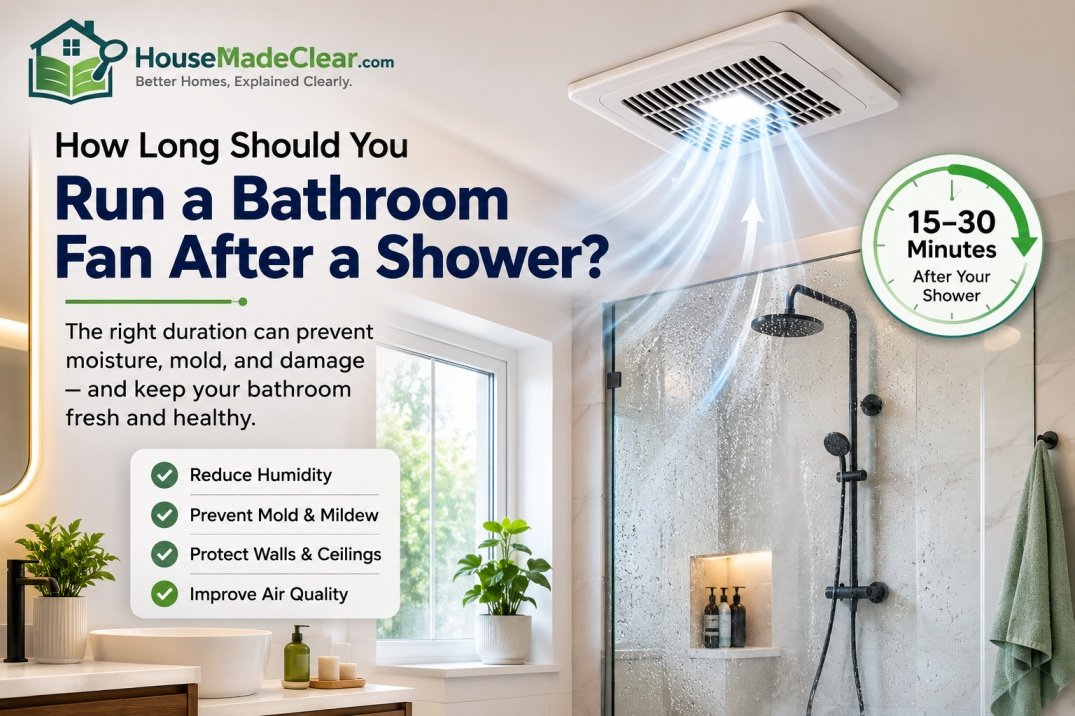
A bathroom exhaust fan should usually keep running for about 20 minutes after a shower.
That does not mean every bathroom will become dry at exactly the 20-minute mark. A large bathroom, long hot shower, weak exhaust fan, restrictive ductwork or humid weather can all increase the amount of time required.
The better approach is to use 20 minutes as a practical starting point and then look at what is actually happening inside the room.
Quick answer: Turn the bathroom exhaust fan on when the shower starts and leave it running for around 20 minutes after you finish. If mirrors, walls or windows remain wet or the room still feels noticeably humid, let the fan run longer and check whether the ventilation system is working effectively.
Bathroom ventilation is only one part of creating a functional bathroom. Lighting, electrical safety, moisture control and fixture placement also need to work together. If you are planning or renovating the room, our guide to planning bathroom lighting for the vanity, ceiling and shower explains those considerations in more detail.
Why You Should Keep the Bathroom Fan Running After a Shower
A shower releases water vapor into a relatively small space.
That moisture can settle on:
- Mirrors
- Painted walls
- Ceilings
- Tiles
- Grout
- Window frames
- Cabinets
- Doors and trim
- Towels
- Bath mats
- Other cool surfaces
The U.S. Environmental Protection Agency recommends bathroom exhaust ventilation as one way of controlling indoor moisture because persistent excess moisture can contribute to mold and deterioration of building materials.
The fan does not instantly remove all this moisture when you turn off the shower.
Humid air remains in the room, while water continues evaporating from:
- Shower walls
- Bathtubs
- Wet towels
- Bath mats
- Glass screens
- Grout
- Tile surfaces
That is why switching the fan off immediately after leaving the shower can be too early.
The 20-Minute Bathroom Fan Rule
For many everyday bathrooms, approximately 20 minutes after showering is a useful starting point.
A simple routine is:
- Turn the bathroom fan on when the shower begins.
- Keep it running throughout the shower.
- Leave it running for around 20 minutes afterward.
- Check whether excess condensation has cleared.
- Run it longer if the room remains noticeably humid.
You do not need to remain in the bathroom waiting for it.
A timer, delay-off switch or humidity-sensing control can make this much easier.
Should You Run the Bathroom Fan During the Shower?
Yes.
Ideally, the exhaust fan should operate during the shower as well as afterward.
Starting the fan before or when the shower begins allows it to remove humid air while moisture is being produced.
This can help reduce:
- Heavy mirror fogging
- Condensation on walls
- Damp ceilings
- Moisture spreading into adjoining rooms
- Excessive humidity after showering
If you wait until the shower is finished before switching on the fan, the room may already contain a considerable amount of humid air.
When 20 Minutes May Not Be Long Enough
Twenty minutes is not a universal maximum.
Some bathrooms may require additional ventilation.
Long or Very Hot Showers
Hotter and longer showers usually introduce more moisture into the room.
If the bathroom is still visibly steamy after 20 minutes, leaving the fan running somewhat longer is reasonable.
Large Bathrooms
A larger bathroom contains a greater volume of air.
The exhaust fan therefore needs sufficient airflow for the size and configuration of the room.
Simply installing the smallest available fan may not provide effective ventilation.
Steam Showers
Steam showers create a much greater moisture load than conventional showers.
They may require:
- Longer ventilation
- Higher-capacity ventilation
- Better enclosure planning
- Suitable finishes
- Proper ducting
A standard 20-minute timer may not be enough after substantial steam use.
Bathrooms Without Windows
In a windowless bathroom, mechanical ventilation may be the main way of removing shower-generated moisture.
That makes fan performance particularly important.
If the bathroom remains damp for a long time despite regular fan use, investigate the ventilation system rather than simply accepting the problem.
Humid Climates
Homes in humid parts of the United States may already have relatively high indoor humidity.
Bathroom moisture can therefore take longer to dissipate.
The exhaust fan still removes locally generated moisture, but whole-home humidity may also need attention.
Several Showers in a Row
In a family bathroom, one person may shower before the moisture from the previous shower has cleared.
When showers happen consecutively:
- Keep the fan running between showers
- Keep it operating throughout each shower
- Continue ventilation after the final shower
Turning the fan off between users usually provides little benefit.
How Do You Know When the Bathroom Is Dry Enough?
Do not judge fan runtime only by the clock.
Look at the condition of the bathroom.
Check the Mirror
A mirror that remains heavily fogged well after the shower suggests the room still contains substantial moisture.
However, the mirror alone should not be your only measure because:
- Mirror temperature affects condensation
- Heated mirrors may remain clear despite high humidity
- Some bathrooms naturally clear mirrors faster than others
Check the Windows
Repeated condensation on bathroom windows can indicate that moisture remains high.
Pay particular attention to:
- Window corners
- Frames
- Sills
- Nearby painted surfaces
Persistent moisture in these areas deserves investigation.
Look at Walls and Ceilings
Watch for:
- Water droplets
- Damp patches
- Peeling paint
- Blistering paint
- Discoloration
- Recurring mildew
- Dark spotting
These signs can suggest that the bathroom is remaining wet too often or too long.
Check the Shower Area
Shower surfaces will obviously remain wet immediately afterward, but they should progressively begin drying.
If tile, grout and surrounding surfaces stay saturated for hours, ventilation may be inadequate.
Consider Using a Humidity Meter
An inexpensive digital hygrometer can help you understand how humidity changes before, during and after a shower.
The number should not be treated as the only measure of bathroom performance, but it can help identify patterns.
For example, you may notice that:
- Humidity rises sharply during showers
- The room takes a long time to recover
- Consecutive showers prevent humidity from falling
- Humidity remains high throughout the entire home
That information can help distinguish a bathroom-specific problem from a broader indoor humidity issue.
If the Fan Runs for 20 Minutes but the Bathroom Is Still Wet
This is an important distinction.
If the room remains wet after reasonable ventilation, the answer may not simply be to run the fan for increasingly long periods.
Something else may be limiting its performance.
Possible causes include:
- Fan too small for the bathroom
- Dirty fan grille
- Restricted ductwork
- Excessively long duct run
- Too many duct bends
- Crushed flexible duct
- Blocked exterior vent
- Poor makeup-air path
- High whole-home humidity
- Incorrect installation
The Bathroom Fan May Be Too Small
Bathroom exhaust fans are normally rated according to airflow.
In the United States, airflow is commonly expressed in CFM — cubic feet per minute.
The correct fan capacity depends partly on:
- Bathroom size
- Ceiling height
- Shower configuration
- Bath or spa features
- Duct design
- Installation conditions
A small fan in a large bathroom can operate for a long time while still providing poor moisture removal.
If you are making broader changes to the room, browse the House Made Clear Bathroom guides before finalizing fixtures, lighting and ventilation separately. The best results usually come from treating these systems as parts of the same room rather than isolated purchases.
The Duct May Be Restricting Airflow
A good fan can perform poorly when connected to a bad duct system.
Airflow may be reduced by:
- Long duct runs
- Excessive bends
- Small-diameter ductwork
- Crushed flexible duct
- Loose connections
- Interior obstructions
- Blocked exterior termination
The airflow printed on the fan packaging is not necessarily the airflow you receive after installation.
Real-world performance depends on the complete exhaust path.
The Fan Should Exhaust Outdoors
Bathroom exhaust air should be discharged outside the building.
It should not simply terminate inside:
- An attic
- Ceiling cavity
- Wall cavity
- Crawl space
Otherwise, moisture has been moved from the bathroom into another part of the building rather than removed from the home.
This can make the original bathroom appear better while creating a hidden moisture problem elsewhere.
If you are unsure where your fan exhausts, have the duct path checked.
A Dirty Fan Can Move Less Air
Dust and debris may accumulate on:
- Fan grille
- Housing
- Fan blades
- Motor area
A visibly clogged grille can restrict airflow.
Follow the manufacturer’s cleaning instructions, and isolate power appropriately before performing maintenance that requires removing covers or accessing electrical components.
If the fan is old, unusually noisy or barely moving air even after cleaning, replacement may be worth considering.
Does the Bathroom Need Makeup Air?
For air to leave the bathroom, replacement air needs a way to enter.
This may occur through:
- Clearance beneath the door
- Transfer grille
- Designed ventilation path
- Other permitted openings
A very tightly sealed bathroom can interfere with exhaust performance.
However, do not modify doors or ventilation openings casually. Fire-rated doors, multifamily buildings and some other properties can have specific requirements.
A Simple Way to Check Whether the Fan Is Pulling Air
You can perform a rough check by holding a lightweight tissue near the fan grille while the fan is running.
The airflow should pull the tissue toward the grille.
This can tell you whether there is at least noticeable suction.
It cannot tell you:
- Actual CFM
- Whether the fan meets code
- Whether the duct is correctly sized
- Whether the exterior termination is suitable
- Whether the complete ventilation system performs adequately
Persistent humidity problems should be assessed more thoroughly.
Should You Leave the Bathroom Door Open After a Shower?
Opening the bathroom door may help move air, but there is a tradeoff.
It can also allow humid air to spread into:
- Bedroom
- Hallway
- Closet
- Other rooms
A functioning exhaust fan is designed to remove moisture from the home rather than simply redistribute it.
If additional makeup air improves fan operation, a slightly open door may help in some situations. But the permanent solution should be a properly designed ventilation arrangement.
Should You Open a Bathroom Window?
A window can sometimes help remove humidity when outdoor conditions are suitable.
However, its effectiveness depends on:
- Outdoor humidity
- Temperature
- Wind
- Rain
- Window position
- Privacy
- Airflow through the room
Opening a window may be less useful during hot and humid weather.
For consistent bathroom moisture control, mechanical exhaust generally gives you more predictable performance.
Is It Bad to Leave a Bathroom Fan Running for Hours?
Leaving a properly functioning bathroom fan running somewhat longer than necessary occasionally is different from routinely leaving it on for hours.
Once excess humidity has cleared, prolonged operation usually provides diminishing benefit.
Potential disadvantages include:
- Unnecessary electricity use
- Additional fan wear
- Noise
- Exhausting conditioned indoor air
The objective is not to operate the fan for as long as possible.
The objective is to remove bathroom moisture efficiently.
That is why automatic controls can be useful.
Are Bathroom Fan Timers Worth Installing?
For many households, a timer is one of the simplest bathroom upgrades.
Instead of relying on someone to remember the fan, a countdown switch can keep it operating after they leave.
Common settings may include:
- 10 minutes
- 20 minutes
- 30 minutes
- 60 minutes
The exact options depend on the product.
Why Separate Fan and Light Controls Can Help
When the fan and main bathroom light operate from the same switch, people naturally turn both off when they leave.
That works poorly if the fan needs another 20 minutes to clear moisture.
Separate controls provide more flexibility.
For example:
- Main ceiling light
- Vanity lighting
- Shower lighting
- Exhaust fan
- Night lighting
This is also why ventilation should be considered during the electrical-planning stage rather than after the bathroom has been completed. House Made Clear’s guide to bathroom lighting layout and controls covers how vanity, ceiling, shower and nighttime lighting can be planned as separate functional layers.
Fixed electrical changes should be completed according to applicable local requirements.
Are Humidity-Sensing Bathroom Fans Worth It?
Humidity sensing can be useful if people regularly forget to use the fan.
A humidity-sensing control may:
- Detect an increase in humidity
- Start ventilation automatically
- Continue operation while humidity remains elevated
- Reduce dependence on user memory
This can be particularly useful in:
- Children’s bathrooms
- Guest bathrooms
- Rental properties
- Busy family bathrooms
However, automatic does not mean maintenance-free.
Sensor behavior can be affected by:
- Sensitivity settings
- Installation position
- Baseline humidity
- Seasonal conditions
- Product design
If a sensor switches on too often or shuts down too quickly, check its settings and manufacturer’s instructions.
What About Motion-Sensor Bathroom Fans?
Occupancy sensing and humidity sensing solve different problems.
A motion sensor can determine that someone entered the room.
It cannot necessarily determine that shower-generated humidity has disappeared.
A fan controlled only by occupancy could therefore stop too soon after a person leaves.
If using occupancy controls, make sure the system includes an adequate delay or another method of managing post-shower ventilation.
How Long Should You Run the Fan After a Bath?
A bath may release less immediate moisture than a hot shower, but this depends on:
- Water temperature
- Bathroom size
- Bath duration
- Room temperature
- Amount of visible steam
For a hot bath, running the fan during use and for around 20 minutes afterward is a reasonable starting point.
Again, actual room conditions matter more than the timer alone.
How Long Should You Run the Fan After a Steam Shower?
A steam shower is different from an ordinary shower.
It deliberately creates a high-humidity environment.
You may need substantially more than 20 minutes of post-use ventilation depending on:
- Steam generation
- Enclosure design
- Bathroom volume
- Exhaust airflow
- Surface temperature
- Duct configuration
- Ambient indoor humidity
If a bathroom containing a steam shower remains excessively damp for a prolonged period, the ventilation system may need specialist assessment.
How Long Should the Fan Run in a Small Bathroom?
A small bathroom does not necessarily mean a five-minute fan runtime.
Humidity can become highly concentrated in a small room.
The same simple approach still works:
- Turn the fan on when showering begins
- Keep it running during the shower
- Continue for roughly 20 minutes afterward
- Observe whether condensation clears
A properly configured humidity sensor may eventually provide better control than guessing the runtime every day.
What If Your Bathroom Does Not Have an Exhaust Fan?
The available solution depends on:
- Property type
- Bathroom location
- Existing ventilation
- Windows
- Local building requirements
- Whether you own or rent
Possible approaches may include:
- Appropriate window ventilation
- Existing mechanical ventilation
- Installation of an exhaust fan
- Whole-home ventilation improvements
- Moisture-control measures
Do not simply use a portable desk fan to blow humid air into the rest of the home. That redistributes moisture rather than removing it.
If you are planning other practical upgrades around the property, the House Made Clear Home Improvement section contains additional guides focused on functionality, maintenance and household improvements.
Does a Dehumidifier Replace a Bathroom Exhaust Fan?
Usually, these devices perform different functions.
Exhaust Fan
An exhaust fan:
- Pulls humid air from the bathroom
- Moves it through ductwork
- Discharges it outdoors
Dehumidifier
A dehumidifier:
- Draws indoor air through the appliance
- Removes some moisture
- Collects or drains water
- Returns the air to the indoor space
A dehumidifier may help manage high indoor humidity, but it should not automatically be treated as a replacement for required or appropriate bathroom exhaust ventilation.
Portable electrical equipment also needs careful placement around bathrooms because water and electricity create additional safety considerations.
Why Does My Bathroom Mirror Stay Fogged for So Long?
Persistent mirror fogging can be associated with several factors:
- Hot showers
- Weak exhaust fan
- Fan located poorly
- Restricted ductwork
- Undersized fan
- High indoor humidity
- Inadequate ventilation
- Cold mirror surface
An anti-fog or heated mirror may keep the mirror itself clearer, but that does not necessarily remove moisture from the bathroom.
That distinction is important.
A clear mirror does not automatically mean the bathroom is properly ventilated.
If you are replacing an illuminated or heated mirror, also review how the mirror interacts with vanity lighting in our bathroom lighting guide.
Why Is Water Dripping From the Bathroom Exhaust Fan?
Water dripping from an exhaust fan should be investigated.
Possible causes can include:
- Condensation inside cold ductwork
- Poorly insulated duct
- Incorrect duct installation
- Exterior rain entering the termination
- Roof or wall penetration problems
- Moisture accumulation in the duct
Reducing fan runtime is not necessarily the correct solution.
If condensation is forming inside the duct, less ventilation may actually leave more moisture in the bathroom.
Have persistent dripping checked rather than assuming the fan itself is producing the water.
Signs Your Bathroom May Need Better Ventilation
Pay attention to recurring problems rather than a single unusually steamy shower.
Possible warning signs include:
- Mirrors stay fogged for a long time
- Windows repeatedly collect condensation
- Water droplets form on walls
- Paint begins peeling
- Ceiling finishes deteriorate
- Grout develops recurring dark spots
- Musty odors persist
- Towels dry very slowly
- Cabinets or trim begin swelling
- Mildew repeatedly returns
These symptoms do not automatically prove that the exhaust fan is the cause, but they justify investigating moisture and ventilation.
Bathroom Ventilation and Lighting Should Be Planned Together
Ventilation and lighting are often treated as completely separate decisions.
In practice, their controls can affect each other.
For example, connecting the exhaust fan only to the primary light switch can encourage users to shut the fan down immediately after the shower.
A more functional bathroom might provide independent controls for:
- Exhaust fan
- Vanity lighting
- General ceiling lighting
- Shower lighting
- Night lighting
If you are renovating rather than simply replacing the fan, start with the entire room plan. Our guide to planning bathroom lighting explains how lighting should be mapped around the vanity, ceiling, shower and bath before fixtures are selected.
A Bathroom Fan Routine That Works for Most Homes
A practical routine is straightforward.
Before or When the Shower Starts
Turn on the exhaust fan.
During the Shower
Keep it operating.
After the Shower
Leave the fan running for approximately 20 minutes.
After About 20 Minutes
Look at:
- Mirror
- Windows
- Walls
- Ceiling
- General humidity
If excessive moisture remains, continue ventilation.
Periodically
Inspect:
- Fan grille
- Visible dust
- Exterior vent
- Unusual noises
- Apparent airflow
- Recurring moisture
The goal is to identify ventilation problems before they become persistent moisture problems.
Common Bathroom Fan Mistakes
1. Turning the Fan On Only After the Shower
Why it is less effective: Moisture has already accumulated.
Better approach: Start ventilation when showering begins.
2. Switching the Fan Off With the Light
Why it fails: Humidity remains after the person leaves.
Better approach: Use a separate switch or timer where appropriate.
3. Assuming Longer Runtime Fixes Everything
Why it fails: An undersized or poorly ducted fan may remain ineffective even when operated longer.
Better approach: Investigate performance when moisture repeatedly persists.
4. Venting Into the Attic
Why it fails: Moisture is moved to another part of the building rather than outside.
Better approach: Exhaust appropriately outdoors.
5. Ignoring a Dirty Grille
Why it fails: Accumulated dust can restrict airflow.
Better approach: Clean according to manufacturer instructions.
6. Assuming a Clear Mirror Means Low Humidity
Why it fails: Heated mirrors and surface temperatures can affect condensation.
Better approach: Assess the whole bathroom.
7. Leaving the Fan Running All Day as the Normal Solution
Why it fails: Excessive runtime can hide an underlying ventilation problem.
Better approach: Determine why normal ventilation is not clearing moisture.
Bathroom Fan Checklist
Before assuming the fan needs to run longer, check:
- Fan runs while showering
- Fan continues for about 20 minutes afterward
- Fan exhausts outdoors
- Grille is reasonably clean
- Exterior termination is not obstructed
- Bathroom has an appropriate makeup-air path
- Mirror clears reasonably after use
- Walls are not staying wet
- Windows do not remain heavily condensed
- Recurring mildew is not developing
- No water is dripping from the fan
- Ductwork appears properly installed
- Fan capacity is appropriate for the room
- Timer works correctly
- Humidity sensor is configured properly if fitted
When Should You Ask a Professional to Check the Bathroom?
Consider professional assessment when:
- Moisture remains severe despite regular fan operation
- Mold repeatedly returns
- Water is dripping from the fan
- You do not know where the exhaust duct terminates
- Ductwork passes through inaccessible areas
- The fan barely moves air
- Electrical controls require modification
- A steam shower is being installed
- You are undertaking a major bathroom renovation
Bathroom systems combine moisture, electricity, ventilation and building materials, so certain problems should not be diagnosed through guesswork alone.
House Made Clear publishes general educational guidance rather than property-specific electrical or building advice. You can review our Disclaimer before undertaking electrical, structural or ventilation changes.
Final Thoughts
For most bathrooms, remember one simple guideline:
Run the exhaust fan while showering and keep it running for about 20 minutes afterward.
Then look at the room.
If condensation has cleared and surfaces are beginning to dry, the ventilation is doing what you want it to do.
If the bathroom remains wet long after every shower, continuously increasing the timer is not necessarily the answer. The fan could be:
- Undersized
- Dirty
- Poorly ducted
- Restricted
- Incorrectly terminated
- Working against unusually high indoor humidity
Good bathroom design is ultimately about making several systems work together—ventilation, lighting, surfaces, electrical controls and daily use.
That functional approach also reflects the practical residential-design perspective behind House Made Clear. You can learn more about the site’s contributor and her experience on the Meet Charu page.
Frequently Asked Questions
How long should I leave the bathroom fan on after a shower?
About 20 minutes after the shower is a useful starting point for many bathrooms. Run the fan during the shower as well. If excessive condensation remains after 20 minutes, continue ventilation and consider whether the fan and duct system are performing properly.
Should the bathroom fan be on while showering?
Yes. Starting the fan when the shower begins allows it to remove humid air while moisture is being produced instead of waiting until the bathroom has already filled with steam.
Is 10 minutes long enough for a bathroom fan?
It may not be enough after a hot or long shower. Approximately 20 minutes of post-shower ventilation is a more useful starting point, although the appropriate runtime depends on the bathroom and moisture conditions.
Can I leave the bathroom exhaust fan on all night?
Occasionally running a properly functioning fan longer than necessary is different from making overnight operation your normal moisture-control strategy. Once excess humidity has cleared, continued operation usually provides limited additional benefit. A timer or humidity-sensing control is generally more practical.
Why is my bathroom still humid after the fan runs for 20 minutes?
Possible reasons include an undersized fan, dirty grille, restricted ductwork, excessive duct length, blocked exterior termination, high indoor humidity or inadequate airflow into the bathroom.
Does opening the bathroom door help remove humidity?
It can improve airflow in some situations, but it may also allow humid air to spread into adjoining rooms. A properly functioning exhaust fan that discharges outdoors is a more direct way of removing bathroom moisture.
Should I open a window when using the bathroom fan?
Usually it is not necessary. A window can help under suitable weather conditions, but its effectiveness depends on outdoor temperature and humidity. The exhaust system should ideally be capable of controlling normal bathroom moisture without depending on an open window.
Can a humidity-sensing bathroom fan turn itself off automatically?
Yes. Some bathroom fans or controls detect changes in humidity and operate automatically. Their effectiveness depends on the product, sensor location, settings and normal humidity conditions in the home.
Does a dehumidifier replace a bathroom exhaust fan?
Not usually. An exhaust fan removes humid bathroom air from the building, while a dehumidifier removes moisture from indoor air and returns that air to the room. They perform different functions.
Why does my bathroom fan drip water?
Possible causes include condensation forming inside cold ductwork, inadequate duct insulation, improper installation or rain entering through an exterior termination. Persistent dripping should be investigated rather than addressed simply by reducing fan runtime.