














A small bedroom without a closet can feel difficult to organize, but the real problem is usually not just the lack of storage.
It is often a combination of:
- Too many items stored in the room
- Furniture that uses floor space inefficiently
- Empty wall space
- Poorly planned clothing storage
- No separation between everyday and occasional items
- Storage pieces that make the room feel even smaller
The solution is not to add as many cabinets, baskets and organizers as possible.
A better approach is to decide what actually needs to stay in the bedroom, how often each item is used, and which parts of the room can store those items without interfering with movement, light or comfort.
Quick answer:
In a small bedroom with no closet, begin with one main clothing-storage system, such as a wardrobe, garment rack or dresser. Then use under-bed space, wall-mounted storage, the area behind the door and multipurpose furniture for smaller items. Keep frequently used belongings easy to reach and move seasonal or rarely used items elsewhere whenever possible.
Start by Deciding What Really Needs to Stay in the Bedroom
Before buying storage furniture, sort the contents of the room.
Divide belongings into four groups:
Daily-use items
Examples include:
- Everyday clothes
- Sleepwear
- Shoes worn regularly
- Work clothes
- Daily accessories
- Frequently used bags
These should be among the easiest things to reach.
Weekly-use items
Examples might include:
- Extra shoes
- Workout clothes
- Spare bedding
- Less frequently worn clothing
These can be stored slightly farther away.
Seasonal items
Examples include:
- Heavy coats
- Winter blankets
- Summer-only clothing
- Holiday items
These do not need premium bedroom storage space throughout the year.
Items That Do Not Need to Be in the Bedroom
This category is often the most important.
A small bedroom becomes difficult to organize when it also stores:
- Old paperwork
- Empty packaging
- Luggage
- Cleaning supplies
- Hobby materials
- Unused electronics
- Household overflow
If another suitable location exists, move these items out before designing additional bedroom storage.
Create One Main Clothing-Storage Zone
Without a built-in closet, clothing can easily spread around the room.
Instead of using several unrelated storage pieces, create one primary clothing zone.
Possible options include:
- Freestanding wardrobe
- Garment rack
- Dresser
- Armoire
- Modular wardrobe system
- Combination of dresser and wall rail
The best option depends on:
- Amount of hanging clothing
- Amount of folded clothing
- Available wall width
- Ceiling height
- Budget
- Whether you rent or own
- How much visual clutter you are comfortable seeing
Option 1: Use a Freestanding Wardrobe
A freestanding wardrobe is the closest substitute for a traditional closet.
It can provide:
- Hanging space
- Shelves
- Drawers
- Closed storage
- A cleaner visual appearance
It works particularly well when you have:
- Dresses
- Jackets
- Shirts
- Work clothes
- Clothing you prefer to keep hidden
Where to Place a Wardrobe
Look first for:
- A long uninterrupted wall
- A corner away from the window
- Space beside the bed
- The wall opposite the bed
Avoid placing it where it:
- Blocks natural light
- Interferes with the bedroom door
- Makes a narrow walkway even tighter
- Blocks HVAC vents
- Prevents drawers from opening
Measure both the cabinet and the door swing before buying.
A wardrobe that technically fits the wall may still be unusable if its doors cannot open properly.
Sliding-Door Wardrobes Can Save Clearance
Sliding doors require less space in front of the wardrobe than hinged doors.
This can be useful in a narrow bedroom.
However, sliding-door designs have their own tradeoffs:
- You cannot see the entire interior at once
- Tracks need maintenance
- Some inexpensive systems have shallow usable depth
The correct choice depends on the layout, not just room size.
Option 2: Use an Open Garment Rack
An open clothing rack can be useful when:
- You rent
- Budget is limited
- You move frequently
- Most clothing needs hanging
- The bedroom cannot accommodate a large wardrobe
A simple rack can hold:
- Shirts
- Jackets
- Dresses
- Pants
- Bags
Some racks also include lower shoe shelves.
The Main Problem With Open Racks
Everything remains visible.
An overloaded rack can quickly make a small bedroom feel cluttered.
To keep it manageable:
- Limit the number of garments
- Use consistent hangers
- Keep the floor beneath it clear
- Store seasonal clothing elsewhere
- Avoid hanging miscellaneous bags from every side
A garment rack works best when it behaves like a small edited closet, not a permanent overflow area.
Option 3: Use a Dresser for Folded Clothing
If most of your clothes can be folded, a dresser may be more useful than a wardrobe.
Dressers work well for:
- T-shirts
- Underwear
- Sleepwear
- Workout clothing
- Sweaters
- Small accessories
The top can sometimes also support:
- Mirror
- Small lamp
- Jewelry tray
But try not to turn the dresser top into another cluttered storage surface.
Tall Dresser vs Wide Dresser
A tall dresser uses less floor width and may suit a compact room.
A low wide dresser can provide:
- Larger top surface
- Visual balance beneath a mirror or artwork
- Easier access to all drawers
Choose based on the available wall rather than assuming one format is better.
Tall furniture should be secured appropriately where tipping is a concern, especially in homes with children. The U.S. Consumer Product Safety Commission continues to emphasize the importance of preventing furniture tip-over hazards. (House Made Clear)
Use the Space Under the Bed
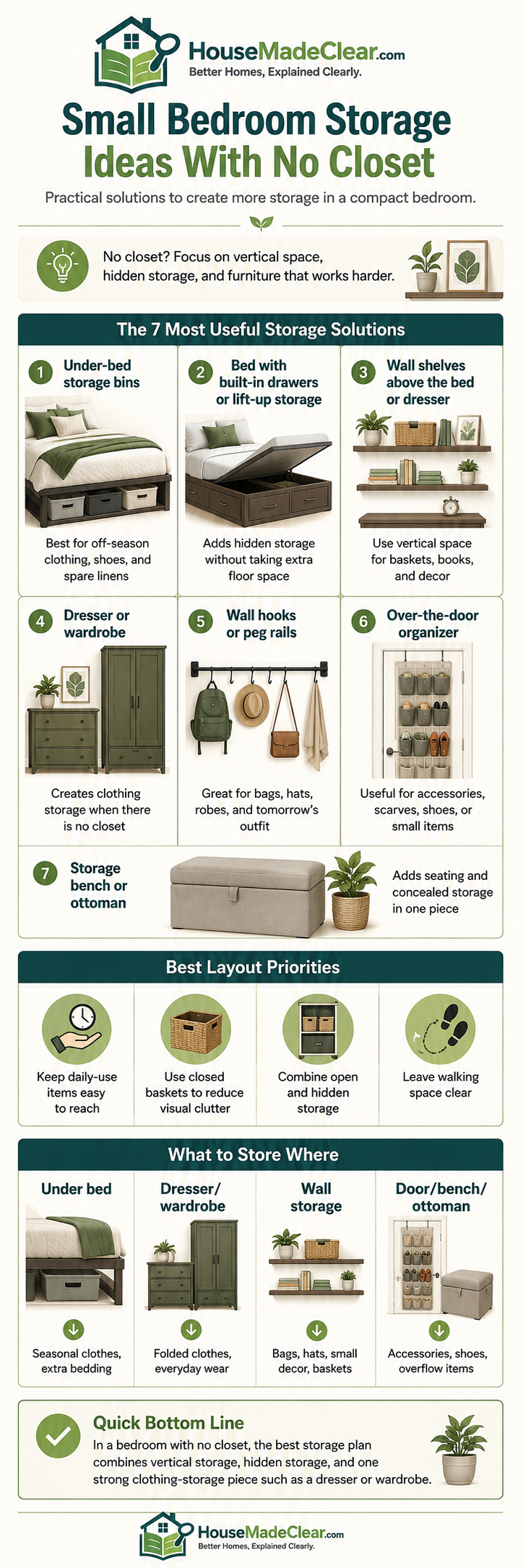
Under-bed storage is one of the most useful areas in a bedroom without a closet.
It can hold:
- Seasonal clothing
- Extra bedding
- Shoes
- Spare towels
- Bags
- Less frequently used clothes
Possible storage options include:
- Low rolling drawers
- Lidded containers
- Fabric storage bags
- Built-in bed drawers
- Lift-up storage beds
Measure Before Buying Under-Bed Containers
Measure:
- Floor-to-bed clearance
- Space between bed supports
- Available width
- Available depth
Do not assume a container marked “under-bed storage” will fit your particular bed.
Choose Containers That Are Easy to Access
A storage box is less useful if you have to:
- Lift the mattress
- Move a nightstand
- Drag furniture
- Remove several other boxes first
Use the easiest-access areas for things you need more often.
Put seasonal items deeper under the bed.
Consider a Storage Bed
If you are replacing the bed anyway, a storage bed can provide considerably more usable space.
Common designs include:
Drawer storage
Drawers are built into the bed frame.
Good for:
- Clothing
- Bedding
- Shoes
Check whether there is enough room beside the bed to open them.
Lift-up storage
The mattress platform lifts to reveal a large compartment.
This can provide substantial storage without requiring side clearance.
It works particularly well for:
- Seasonal bedding
- Luggage
- Bulky clothing
However, items used daily may be less convenient to access.
Do not replace a perfectly functional bed solely to create storage unless the additional capacity genuinely solves the room’s problem.
Use Vertical Wall Space
When floor space is limited, look upward.
Unused wall areas can hold:
- Shelves
- Hooks
- Pegboards
- Wall cabinets
- Clothing rails
But vertical storage should remain controlled.
Covering every wall with storage can make a small bedroom feel more crowded rather than more functional.
Install Shelves Above a Dresser
The wall above a dresser is often underused.
A shelf can hold:
- Storage boxes
- Books
- Small baskets
- Accessories
Keep heavier or frequently handled items within safe reach.
Do not overload shelves or install them without appropriate fixings for the wall construction and expected weight.
Use High Shelves for Occasional Items
A high shelf near the ceiling can be useful for:
- Seasonal boxes
- Spare bedding
- Light luggage
This works best for items you rarely need.
Daily-use clothing stored near the ceiling quickly becomes inconvenient.
Add Hooks for Frequently Used Items
Hooks can organize:
- Robe
- Tomorrow’s outfit
- Handbag
- Hat
- Light jacket
Possible locations include:
- Behind the bedroom door
- Side of a wardrobe
- Empty wall section
- Inside wardrobe doors
Avoid using hooks as unlimited storage.
Five neatly hung items can be useful.
Twenty hanging items become another cluttered wall.
Use the Back of the Bedroom Door
The area behind the door often has storage potential without consuming floor space.
Possible uses include:
- Over-door hooks
- Slim organizer
- Shoe organizer
- Hanging accessory storage
Check:
- Door clearance
- Hardware thickness
- Wall behind the open door
- Whether the organizer prevents the door closing properly
Avoid putting heavy storage on a door unless the hardware and product are designed for it.
Turn a Nightstand Into Storage
A small bedroom may not have enough space for decorative bedside furniture.
Choose a nightstand that also provides useful storage.
Look for:
- Drawer
- Cabinet
- Shelf
- Compact footprint
It can store:
- Charging cables
- Reading material
- Medication where appropriately stored
- Small electronics
- Personal items
A small chest of drawers can sometimes replace a traditional nightstand entirely.
This allows one piece of furniture to perform two roles.
Use Both Sides of the Bed Carefully
A perfectly symmetrical bedroom is not always the most functional one.
If the room is narrow, two large nightstands may consume valuable space.
Alternatives include:
- One full nightstand and one small shelf
- Wall-mounted bedside shelves
- Narrow bedside tables
- One shared storage unit where appropriate
The layout should reflect actual use rather than a photograph of a perfectly symmetrical bedroom.
The same principle applies in other rooms: circulation and everyday movement should come before decoration. House Made Clear’s guide to planning a functional living room layout explains this space-planning approach in more detail.
Use Wall-Mounted Bedside Shelves
A floating shelf beside the bed can replace a nightstand when floor space is extremely limited.
It can hold:
- Phone
- Glasses
- Small lamp
- Book
Advantages include:
- Clear floor
- Easier cleaning
- Less visual bulk
But it offers little hidden storage.
Use it when you need a surface more than a cabinet.
Store Shoes Vertically
Shoes can consume a surprising amount of bedroom floor space.
Possible solutions include:
- Narrow shoe cabinet
- Low shoe rack
- Under-bed shoe containers
- Hanging shoe organizer
- Bottom shelf of a garment rack
Keep frequently worn shoes easiest to reach.
Store occasional or seasonal shoes farther away.
Avoid Large Open Shoe Collections
Rows of visible shoes can create visual clutter, particularly in a small bedroom.
If you own many pairs, consider keeping only the current rotation in the room.
Use a Narrow Shoe Cabinet
Some slim shoe cabinets use tilted compartments and require relatively little floor depth.
They can work in:
- Narrow wall sections
- Space near the bedroom entrance
- Between a wardrobe and door
Measure carefully because handles, baseboards and door swing can reduce usable space.
Use Baskets Strategically
Baskets can organize small loose items, but adding baskets everywhere does not automatically create organization.
Use them for defined categories such as:
- Scarves
- Belts
- Accessories
- Exercise gear
- Spare linens
Label closed or identical baskets if you frequently forget what they contain.
Avoid the “Miscellaneous Basket”
A basket labeled mentally as “things I don’t know where to put” eventually becomes another source of clutter.
Every container should have a purpose.
Add Storage Above the Bed Carefully
The wall above the bed may look like an obvious storage opportunity, but it needs extra caution.
Avoid casually mounting:
- Heavy cabinets
- Large unstable shelves
- Heavy decorative objects
directly above where someone sleeps.
If storage is required in that area, use appropriately designed and securely installed systems, and follow product instructions and suitable installation practices.
A safer alternative may be storage on the wall beside or opposite the bed.
Create a Mini Closet Along One Wall
If the bedroom has one free wall, you can create a closet-like zone without building a permanent closet.
Possible combination:
- Clothing rail
- Low dresser
- Upper shelf
- Storage baskets
This creates one concentrated storage wall.
Benefits include:
- Easier organization
- Less furniture scattered around room
- Clearer visual zoning
A curtain can sometimes be installed in front of the storage zone to hide clothing.
This gives the room a calmer appearance without requiring a full built-in wardrobe.
Use a Curtain to Hide Open Storage
A ceiling or wall-mounted curtain can conceal:
- Garment rack
- Shelves
- Clothing rail
- Storage boxes
This can be useful for renters because it may require less permanent construction than a built-in closet.
If you use a curtain, determine rod or track placement before selecting panel length. Our guide to how high to hang curtains explains rod height, width and floor-clearance planning.
Build Storage Around an Alcove
An awkward recess can become valuable storage.
Depending on dimensions, an alcove may accommodate:
- Clothing rail
- Shelves
- Dresser
- Small wardrobe
- Desk with upper storage
Measure the recess at:
- Top
- Middle
- Bottom
Older walls are not always perfectly straight.
Use Corners More Efficiently
Corners are often left empty because conventional furniture does not fit them well.
Possible uses include:
- Narrow corner shelves
- Small garment rail
- Tall basket
- Corner hooks
Do not force a large corner cabinet into a small room unless it genuinely improves storage.
Sometimes leaving the corner open makes circulation easier.
Look at the Space at the Foot of the Bed
If there is adequate walking clearance, the foot of the bed may support:
- Storage bench
- Low trunk
- Narrow cabinet
A storage bench can hold:
- Bedding
- Blankets
- Seasonal clothing
It can also provide seating.
However, in a very small bedroom, a bench may make movement more difficult.
Protect the walking route before adding more furniture.
Use Multipurpose Furniture
Small bedrooms benefit when one piece serves more than one function.
Examples include:
- Storage bed
- Dresser as nightstand
- Storage bench
- Desk with drawers
- Ottoman with internal storage
- Wardrobe with mirror
- Headboard with shelving
Multipurpose furniture is most useful when both functions are genuinely needed.
A storage ottoman that is never used for seating may simply be an expensive storage box.
Consider a Desk With Storage
If the bedroom also functions as a home office, do not create completely separate furniture systems for work and storage unless the room can support them.
A desk with:
- Drawers
- Shelves
- Cable management
may reduce the need for another cabinet.
House Made Clear’s guide to designing a functional home office explains how desk placement, storage, lighting and movement should work together.
Keep Work Storage Separate From Clothing
In a bedroom office, visual clutter can increase quickly when clothing, paperwork and electronics mix together.
Use defined zones:
Clothing zone
- Wardrobe
- Dresser
- Garment rack
Work zone
- Desk
- Files
- Charger storage
Bedside zone
- Nightstand
- Personal items
This makes it easier to reset the room at the end of the day.
Use the Window Wall Carefully
The wall around a window may offer storage space, but do not block useful daylight.
Possible options include:
- Low dresser beneath window
- Narrow shelves beside window
- Window seat with storage
- Built-in cabinetry around window
Avoid placing tall wardrobes where they block a meaningful amount of natural light.
In a small room, preserving daylight can sometimes make the space feel more comfortable than adding another storage unit.
Add Storage Around the Headboard
A storage headboard can provide room for:
- Books
- Small personal items
- Charging
- Bedside essentials
Some systems combine:
- Headboard
- Shelves
- Side cabinets
This can replace separate nightstands.
But deep cabinetry around the bed can also make the sleeping area feel enclosed.
Check scale carefully.
Use Mirrors Without Sacrificing Storage
A bedroom without a closet often also lacks a full-length mirror.
Instead of adding a standalone mirror that consumes floor space, consider:
- Mirror on wardrobe door
- Wall-mounted mirror
- Mirror on bedroom door where appropriate
- Mirrored cabinet
Mirrors can make the room feel visually lighter, but their practical value should come first.
Do not add mirrored furniture everywhere simply to make the room appear larger.
Store Accessories in Shallow Space
Jewelry, belts, watches and other accessories do not need deep furniture.
They can often fit in:
- Shallow drawers
- Wall organizers
- Small boxes
- Drawer dividers
- Inside cabinet doors
Using deep shelves for tiny items wastes useful volume.
Match container size to the object being stored.
Divide Dresser Drawers
Large drawers often become inefficient because small clothing items mix together.
Simple dividers can separate:
- Socks
- Underwear
- Accessories
- T-shirts
- Workout items
This does not create more physical space, but it can make the existing space easier to use.
Fold Clothing According to the Drawer
The best folding method is the one that:
- Fits the drawer
- Keeps items visible
- Makes them easy to remove
- Does not require refolding everything constantly
There is no need to force a particular organization method if it makes daily use harder.
Use Storage Boxes on Top of a Wardrobe
The space above a freestanding wardrobe can be useful for lightweight, occasional items.
Suitable uses may include:
- Seasonal clothing
- Spare linens
- Empty travel bags
Use closed, clearly labeled containers where practical.
Avoid stacking unstable or very heavy objects overhead.
Do Not Forget Luggage
Suitcases are bulky and can consume valuable bedroom space.
Possible locations include:
- Under the bed
- Top of wardrobe
- Another household storage area
You can also store some lightweight travel items inside an unused suitcase.
However, if you travel frequently, do not bury the suitcase behind several layers of storage.
Make Seasonal Rotation Part of the System
A small bedroom may never have enough convenient storage for an entire year’s wardrobe.
Seasonal rotation can help.
For example:
During warmer months
Move out:
- Heavy sweaters
- Winter jackets
- Thick blankets
During colder months
Store:
- Lightweight summer clothes
- Beach items
- Seasonal accessories
This keeps the everyday storage zone focused on what is currently being used.
Storage Ideas for Renters
Renters may want solutions that require minimal permanent changes.
Consider:
- Freestanding wardrobe
- Garment rack
- Over-door organizer
- Under-bed boxes
- Dresser
- Storage bed
- Tension-based systems where suitable
- Removable hooks within product limits
Always follow:
- Product instructions
- Lease requirements
- Landlord rules
Do not assume every adhesive product is damage-free on every wall finish.
Small Bedroom Storage for Couples
Two people’s belongings can overwhelm a small room quickly.
Instead of dividing every storage piece exactly in half, organize based on what each person actually owns.
For example:
One person may require more hanging space.
The other may need more drawer storage.
Create:
- Separate drawer zones
- Defined hanging sections
- Individual bedside storage
- Shared seasonal storage
Clear ownership reduces misplaced items and duplicate storage.
Storage Ideas for Children’s Small Bedrooms
Children’s bedrooms need storage that changes as they grow.
Useful categories may include:
- Daily clothes
- Toys
- Books
- School items
- Seasonal clothing
Prioritize:
- Easy-access storage for daily items
- Lower storage for age-appropriate independent use
- Secure furniture
- Limited open clutter
Freestanding dressers and similar furniture should be appropriately secured to reduce tip-over risk. The CPSC has specific safety requirements and guidance related to clothing-storage-unit stability in the United States.
What About Vacuum Storage Bags?
Vacuum bags can reduce the volume of bulky soft items such as:
- Spare bedding
- Seasonal clothing
They may be useful under the bed or in luggage.
However:
- Not every fabric should be compressed long term
- Bags can lose their seal
- They do not reduce the number of items you own
Use them selectively rather than as an excuse to keep unlimited possessions.
Do Not Turn Every Surface Into Storage
One of the most common mistakes in a small bedroom is using every visible surface to hold objects.
This includes:
- Top of dresser
- Nightstand
- Window sill
- Headboard
- Desk
- Floor beside bed
Technically, this creates storage.
Visually, it creates clutter.
Leave some open surfaces.
A small room often feels more functional when storage is concentrated rather than spread across every available area.
Closed Storage vs Open Storage
Both can work.
Closed storage is useful for:
- Clothing
- Visual clutter
- Personal items
- Bedding
- Mixed categories
Open storage is useful for:
- Everyday clothing
- Books
- Decorative items
- Frequently used objects
In a small bedroom, too much open storage can create visual noise.
A useful balance might be:
- One open garment rail
- One closed dresser
- Closed under-bed containers
rather than making every storage area visible.
Keep the Floor as Clear as Possible
A visible floor helps a small bedroom feel easier to move through.
Avoid leaving:
- Shoe piles
- Bags
- Laundry baskets in walkways
- Storage boxes beside furniture
- Loose clothing
Use:
- Wall storage
- Under-bed storage
- Elevated furniture
- Defined laundry location
The goal is not just visual spaciousness.
Clear floors also make everyday movement and cleaning easier.
Choose a Defined Laundry Location
Dirty clothes quickly create clutter in bedrooms without closets.
Choose one dedicated place:
- Slim hamper
- Lidded basket
- Divided laundry bin
- Hanging hamper
Place it where clothes are normally changed.
If the hamper is inconvenient, clothing is more likely to end up on the floor or chair.
Be Careful With the “Bedroom Chair”
Many bedrooms have a chair that slowly becomes a clothing-storage system.
If you genuinely use the chair for seating, keep it.
If it exists mainly to hold clothes, consider replacing the behavior with:
- Wall hooks
- Valet stand
- Small garment rail
- Defined rewear basket
This creates a deliberate location for clothes that are not ready for laundry but are not being returned to the wardrobe.
Create a Rewear Zone
Not every piece of clothing is either clean enough for the wardrobe or dirty enough for laundry.
Without a defined location, these clothes often end up on:
- Chair
- Bed
- Floor
A small rewear zone can include:
- Two wall hooks
- Small valet stand
- One section of garment rack
Keep the capacity limited.
When it becomes full, reset it.
Use Labels Where They Actually Help
Labels are useful for storage that is:
- Closed
- High up
- Seasonal
- Used by multiple people
Examples:
- Winter bedding
- Summer clothes
- Travel accessories
They are less necessary for transparent or frequently used drawers where the contents are obvious.
Avoid Buying Organizers Before You Declutter
A common storage mistake is purchasing:
- Baskets
- Boxes
- Drawer inserts
- Shelves
before deciding what actually needs to be stored.
The result can be a room full of containers rather than a room with more usable space.
Follow this order:
- Remove unnecessary belongings.
- Group remaining items.
- Decide where each category belongs.
- Measure the space.
- Buy only the organizers required.
Common Small-Bedroom Storage Mistakes
1. Adding Too Much Furniture
Why it fails:
Storage capacity increases, but usable floor space disappears.
Better approach:
Choose fewer pieces that provide more useful storage.
2. Ignoring Vertical Space
Why it fails:
Walls remain empty while floor space becomes crowded.
Better approach:
Use selected shelves or hooks where they solve a real problem.
3. Buying a Huge Wardrobe
Why it fails:
The wardrobe may dominate the room and restrict movement.
Better approach:
Measure the room and your clothing needs before choosing size.
4. Using Only Open Storage
Why it fails:
The room can look cluttered even when everything is technically organized.
Better approach:
Mix open and closed storage.
5. Storing Daily Items in Hard-to-Reach Places
Why it fails:
You stop using the storage system.
Better approach:
Reserve easiest-access areas for everyday belongings.
6. Keeping Every Season in Prime Storage
Why it fails:
Current clothing competes with items not being used for months.
Better approach:
Rotate seasonal items.
7. Filling Every Wall
Why it fails:
The bedroom begins to feel enclosed.
Better approach:
Keep at least some visual breathing room.
8. Ignoring Door and Drawer Clearance
Why it fails:
Furniture fits physically but cannot be used properly.
Better approach:
Measure furniture when open, not only when closed.
9. Putting Heavy Storage Over the Bed
Why it fails:
Poorly selected or installed overhead items can create unnecessary risk.
Better approach:
Use suitable, securely installed systems and consider safer alternative locations.
10. Creating Too Many Storage Categories
Why it fails:
The system becomes too complicated to maintain.
Better approach:
Use broad, obvious categories.
Step-by-Step Plan for a Small Bedroom With No Closet
Step 1: Remove Everything That Does Not Belong
Start with obvious clutter and household overflow.
Step 2: Sort Clothing
Separate:
- Hanging
- Folded
- Shoes
- Accessories
- Seasonal
Step 3: Measure the Room
Record:
- Wall widths
- Ceiling height
- Door swing
- Window
- Bed
- Walkways
Step 4: Choose One Main Clothing System
Select:
- Wardrobe
- Garment rack
- Dresser
- Combination system
Step 5: Use Under-Bed Storage
Move occasional and seasonal items below the bed.
Step 6: Add Limited Vertical Storage
Use:
- Shelf
- Hooks
- Rail
only where needed.
Step 7: Improve Bedside Storage
Replace purely decorative furniture with storage-capable alternatives if useful.
Step 8: Organize Shoes
Create one defined shoe-storage area.
Step 9: Add a Laundry and Rewear Zone
Prevent clothes from collecting on furniture.
Step 10: Review the Floor
Remove anything that interferes with walking.
Step 11: Live With the Setup
Use the bedroom for several days.
Notice which items repeatedly end up in the wrong place.
Step 12: Add Organizers Only Where Needed
Buy baskets, dividers or boxes only after real storage problems become clear.
Example Layout: Very Small Bedroom
Imagine a small bedroom with:
- Bed against one wall
- One free wall
- Window opposite
- No closet
A practical setup could be:
Free wall
- Narrow wardrobe
- Small set of drawers
Under bed
- Seasonal clothing
- Extra bedding
Behind door
- Two hooks
- Small organizer
Beside bed
- One drawer nightstand
- One floating shelf
Window wall
Keep mostly open to preserve light.
This creates several storage layers without filling every wall with furniture.
Example Layout: Small Bedroom With Home Office
If the room also needs a desk:
Clothing wall
Use one wardrobe or garment rack.
Bed zone
Use under-bed storage.
Work wall
Use a compact desk with drawers.
Vertical space
Add one shelf above the desk.
Door
Use hooks for daily clothing.
Keeping the work and clothing zones visually separate can help the room remain functional throughout the day. For more detailed workspace planning, see our guide to designing a functional home office.
Small Bedroom Storage Checklist
Before buying additional storage, check:
- Unnecessary belongings removed
- Daily clothing identified
- Seasonal clothing separated
- Main clothing-storage zone selected
- Wardrobe or dresser measured
- Doors and drawers can open fully
- Under-bed clearance measured
- Shoes have a defined location
- Laundry has a defined location
- Rewear clothing has a defined location
- Bedroom door remains usable
- Window is not unnecessarily blocked
- HVAC vents remain clear
- Walking route remains open
- Heavy furniture is appropriately secured
- Overhead storage is safely installed
- Open shelves are not overcrowded
- Work items are separated from clothing
- At least some surfaces remain clear
Final Thoughts
A small bedroom without a closet does not need storage in every possible gap.
It needs a clear hierarchy of storage.
Start with one main place for clothing.
Then use:
- Under-bed space
- Selected vertical storage
- Multipurpose furniture
- Door space
- Small organizers
for the items that remain.
The most important principle is to keep frequently used belongings easy to reach while preventing occasional items from occupying the room’s most valuable storage areas.
A functional small bedroom should still have:
- A clear route to the bed
- Access to the window
- Enough space to open furniture
- Useful daylight
- Areas that are not covered with belongings
Adding another cabinet is not always the answer. Sometimes the bigger improvement comes from reducing what the bedroom is expected to store.
This practical approach to storage and space planning is also central to House Made Clear’s wider Interior Design guidance. The site focuses on creating rooms that work for everyday life rather than simply adding decorative features, drawing on Charu’s practical interior-design experience.
Frequently Asked Questions
How do you store clothes in a bedroom with no closet?
Use one main clothing system such as a freestanding wardrobe, garment rack or dresser. Keep daily clothes there and move seasonal items to under-bed containers, high shelves or another suitable storage area.
What is the best storage for a small bedroom without a closet?
The best setup usually combines one primary clothing-storage piece with under-bed storage and limited vertical storage. The exact combination depends on whether most of your clothes need hanging or folding.
How can I hang clothes without a closet?
You can use a freestanding garment rack, wall-mounted clothing rail or freestanding wardrobe. Keep the amount of visible clothing controlled so the bedroom does not become visually cluttered.
How can I store clothes in a small bedroom without taking up much floor space?
Use under-bed containers, a tall dresser, wall-mounted storage and a compact garment rail. Multipurpose furniture such as a storage bed can also increase capacity without adding another separate cabinet.
Where should I put shoes if I do not have a closet?
Shoes can be stored in a narrow shoe cabinet, under-bed organizer, lower wardrobe shelf, shoe rack or over-door organizer. Keep the pairs you wear most often easiest to reach.
Are open garment racks good for small bedrooms?
They can be, especially for renters or people with limited hanging clothes. However, overloaded open racks create visual clutter quickly, so they work best when the clothing collection is edited and organized.
Is under-bed storage a good idea?
Yes. Under-bed storage is especially useful for seasonal clothing, extra bedding and less frequently used items. Measure the available clearance before buying containers and keep daily items in easier-to-access storage.
How do I make a small bedroom look less cluttered?
Concentrate storage into a few defined zones, keep the floor clear, use some closed storage and avoid filling every visible surface. Moving seasonal and unnecessary items out of the room can also make a major difference.
What can I use instead of a wardrobe?
Depending on your clothing, alternatives include a garment rack, dresser, wall-mounted clothing rail, modular shelving system or a combination of drawers and hanging storage.
Divide storage according to each person’s actual needs rather than splitting every piece of furniture equally. Give each person defined drawer or hanging sections and use shared storage for bedding or seasonal items.