
















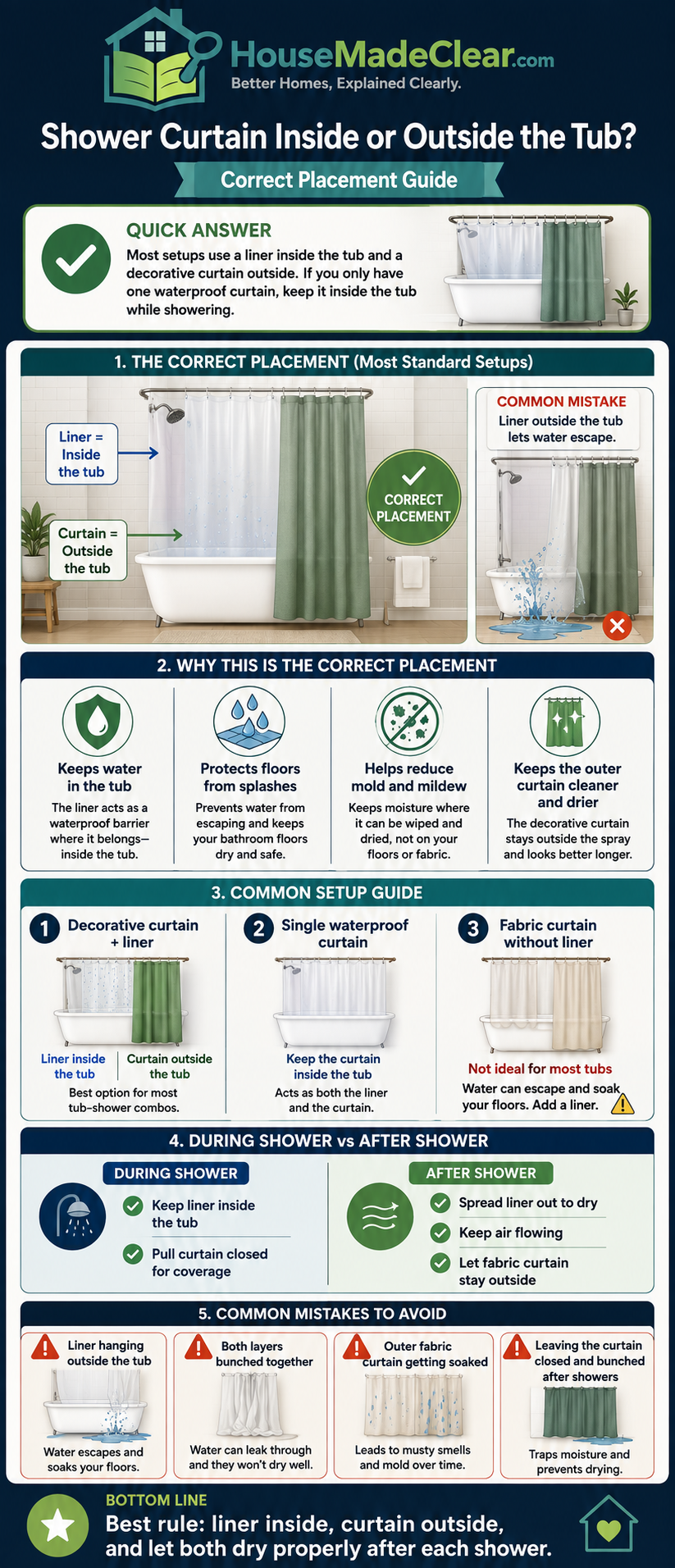
For a standard bathtub-and-shower combination, the shower curtain liner should normally hang inside the tub while you shower, while the decorative shower curtain stays outside.
That arrangement is designed to keep water where it belongs.
Water hitting the liner runs downward and drains back into the bathtub instead of reaching the bathroom floor. The outer curtain remains relatively dry and can continue serving its main purposes: privacy and appearance.
Confusion usually happens because people use the terms shower curtain and shower liner interchangeably. If you have only one waterproof shower curtain with no separate liner, that water-resistant layer generally needs to hang inside the tub during showering.
Quick Answer
Shower liner: inside the bathtub while showering.
Decorative shower curtain: outside the bathtub.
If you use only one waterproof or liner-free shower curtain, place the lower portion inside the tub while the shower is running so water drains back into the bathing area.
After showering, you can spread the curtain and liner across the rod so they dry more effectively.
The basic rule is simple:
The layer that catches shower water belongs inside the wet area.
Should Shower Curtains Be Inside or Outside?
The answer to should shower curtains be inside or outside depends on what you mean by “shower curtain.”
A traditional setup has two layers:
- Decorative shower curtain
- Waterproof or water-resistant liner
In that arrangement:
Decorative curtain → outside the tub
Shower liner → inside the tub
If your bathroom uses only a single waterproof curtain, that curtain performs the liner’s job and should generally hang inside the tub while the shower is operating.
The goal is not based on appearance.
It is based on where water will travel.
Shower Curtain Inside Tub or Outside: The Simple Rule
If you are deciding shower curtain inside tub or outside, ask one question:
Which layer is supposed to catch the shower water?
That layer goes inside.
For a two-layer setup:
| Layer | During Shower |
|---|---|
| Decorative shower curtain | Outside tub |
| Waterproof shower liner | Inside tub |
For a one-layer setup:
| Layer | During Shower |
|---|---|
| Waterproof or liner-free shower curtain | Inside tub |
This keeps water flowing toward the bathtub drain rather than onto the bathroom floor.
Does the Shower Curtain Go Inside the Tub?
If by “shower curtain” you mean the decorative outer layer, usually no.
It normally remains outside.
If you are using a single shower curtain without a separate liner and the curtain is specifically designed for direct water exposure, then yes—the lower portion should normally hang inside the tub while showering.
That distinction resolves most confusion around does the shower curtain go inside the tub.
Does Shower Curtain Go Inside Bathtub?
Again, it depends on whether the curtain is acting as the waterproof layer.
Two-Layer Setup
- Liner goes inside
- Decorative curtain stays outside
Single Waterproof Curtain
- Curtain goes inside during showering
The purpose is always the same:
keep water inside the bathtub.
Does the Shower Curtain Go Inside or Outside the Bathtub?
For most conventional bathrooms:
The liner goes inside the bathtub.
The decorative shower curtain stays outside the bathtub.
This creates a practical division of labor.
The liner deals with:
- Water
- Splash
- Soap residue
The outer curtain deals primarily with:
- Privacy
- Color
- Pattern
- Bathroom design
If you are unsure whether your curtain actually requires a separate liner, House Made Clear’s shower curtain vs liner guide explains when one layer is enough and when two layers make more sense.
Are Shower Curtains Supposed to Be Inside or Outside?
People asking are shower curtains supposed to be inside or outside often have only one visible curtain and no obvious liner.
Look at the material.
If it is:
- Cotton
- Linen
- Decorative fabric
it will usually benefit from a separate liner.
If it is:
- PEVA
- EVA
- Waterproof polyester
- Liner-free shower curtain
it may itself be designed as the water-managing layer.
Whatever catches the water should sit inside the wet area while the shower is being used.
Do Shower Curtains Go Inside or Outside the Tub?
For most two-layer setups:
liner inside, curtain outside.
That is the clearest answer to do shower curtains go inside or outside the tub.
Leaving both layers outside can allow water running down the liner to drip onto:
- Bathroom floor
- Bath mat
- Baseboards
- Nearby cabinetry
Putting both layers inside can unnecessarily soak the decorative curtain and reduce space inside the tub.
The split arrangement solves both problems.
Does Shower Liner Go Inside or Outside Tub?
The shower liner goes inside the tub during showering.
This is the most important placement rule in a traditional shower-curtain system.
The liner’s job is to catch water.
If it hangs outside, gravity works against you.
Water travels down the liner and can drip directly onto the bathroom floor.
Inside the tub, that same water travels toward the tub floor and drain.
Which Side of the Shower Curtain Liner Faces Out?
The question which side of the shower curtain liner faces out depends on the liner design.
Some liners have an obvious:
- Smooth side
- Textured side
- Finished side
- Printed side
Others look almost identical on both sides.
There is no universal orientation for every liner material.
Check:
- Packaging
- Care label
- Manufacturer instructions
If the manufacturer specifies a wet side, follow it.
If both sides are identical and no instructions are provided, placement inside the tub generally matters more than which surface faces the water.
Which Way Does a Shower Liner Go?
For which way does a shower liner go, think about two separate questions.
Where Does It Hang?
Inside the tub during showering.
Which Surface Faces the Shower?
Follow the manufacturer’s design.
Some liners have:
- Magnets at bottom
- Weighted hem
- Decorative finish
- Specialized coating
that may make orientation obvious.
Do not assume that every smooth side or textured side follows one universal rule.
Why Does the Shower Liner Go Inside the Tub?
Water follows gravity.
If shower spray hits the liner, droplets travel down its surface.
When the liner is inside the bathtub:
water → liner → tub → drain
When the liner is outside:
water → liner → bathroom floor
That is why liner placement is more than a style preference.
It is part of basic water management.
Why Does the Decorative Curtain Stay Outside?
A decorative curtain may be made from:
- Polyester
- Cotton
- Linen
- Fabric blends
and often has:
- Pattern
- Texture
- Printed design
Keeping it outside reduces its exposure to direct shower spray.
That can help it:
- Stay cleaner
- Dry faster
- Maintain appearance
- Avoid unnecessary soaking
The liner takes the harsher wet-side role.
Can Both the Shower Curtain and Liner Go Inside the Tub?
They can physically fit inside, but that is usually unnecessary.
Putting both inside may:
- Reduce usable shower space
- Wet the outer curtain
- Create more damp fabric
- Slow drying
For a standard bathtub:
liner inside + curtain outside
is generally the cleaner arrangement.
Can Both Stay Outside the Tub?
They should not both remain outside while the shower is running.
If the liner stays outside, water can run down onto the floor.
This is one of the most common reasons for:
- Wet bath mats
- Puddles near tub
- Damp flooring
If your bathroom floor gets wet after every shower, check liner placement before assuming you have a plumbing problem.
What If You Only Have a Shower Curtain and No Liner?
If the curtain is designed for direct water exposure, it can often be used by itself.
Examples may include certain:
- Waterproof polyester curtains
- PEVA curtains
- EVA curtains
- Liner-free shower curtains
During showering, let the curtain hang inside the tub so water drains properly.
If your curtain is decorative fabric and becomes saturated every time, adding a separate liner is usually more practical.
What If You Only Have a Shower Liner?
A liner can be used alone.
It does not need a decorative curtain to function.
The liner can provide:
- Water containment
- Privacy, depending on opacity
This is common in:
- Rental bathrooms
- Guest bathrooms
- Minimalist bathrooms
Keep it inside the tub during showering.
Does a Polyester Shower Curtain Go Inside or Outside?
It depends on how the polyester curtain is designed.
Polyester Decorative Curtain With Liner
Keep the curtain outside.
Keep the liner inside.
Waterproof or Liner-Free Polyester Curtain
Place it inside while showering because it is serving as the water barrier.
Material alone does not tell you everything.
Read the product description and care label.
Does a Fabric Shower Curtain Go Inside or Outside?
A decorative fabric curtain usually stays outside.
Fabric materials such as:
- Cotton
- Linen
- Decorative polyester
are commonly paired with a liner.
The liner catches direct water while the outer fabric remains relatively dry.
Does a Plastic Shower Curtain Go Inside the Tub?
If your “shower curtain” is actually a waterproof plastic or plastic-like curtain being used without a separate liner, yes.
It should generally hang inside the bathtub while showering.
That allows water running down the curtain to drain back into the tub.
Shower Curtain vs Liner Placement
The easiest way to remember the arrangement is:
Pretty layer outside.
Water layer inside.
Not every bathroom uses a decorative curtain, but the rule remains useful.
The layer designed to receive shower spray belongs in the shower area.
How Far Inside the Tub Should the Liner Hang?
The liner does not need to extend all the way across the tub floor.
It should hang naturally down the inside wall of the bathtub.
You want enough overlap below the tub rim that the liner:
- Remains inside
- Does not easily flip outward
- Directs water downward
But it should not be so long that several inches of material pile on the tub floor.
Should a Shower Liner Touch the Bottom of the Tub?
Usually it does not need to.
Excess liner lying on the bathtub floor can:
- Stay wet
- Collect soap residue
- Become slippery
- Dry slowly
A correctly sized liner should extend comfortably inside the bathtub without creating unnecessary pooling.
How Low Should the Shower Liner Hang?
The ideal position depends on:
- Tub height
- Rod height
- Liner length
- Hook drop
The liner needs enough overlap with the bathtub wall to keep water inside.
If it barely reaches below the tub rim, either:
- Rod may be too high
- Liner may be too short
If it piles heavily on the tub floor:
- Rod may be too low
- Liner may be too long
House Made Clear’s guide to shower curtain rod height explains how to calculate the proper position.
Why Does My Liner Keep Coming Out of the Tub?
Several things can cause this.
Liner Is Too Short
There may not be enough material below the rim.
Rod Is Too High
This raises the entire liner.
Shower Airflow Moves It
Lightweight liners can move inward or outward.
Tub Edge Is Shallow
Some tub designs provide less containment.
Liner Is Too Narrow
It may pull tight when closed and move away from the sides.
Solutions may include:
- Longer liner
- Lower rod
- Wider liner
- Weighted hem
- Correct rod placement
Why Does the Shower Curtain Blow Into the Tub?
A lightweight shower curtain or liner can move inward while the shower is running.
This happens because moving water and air create pressure differences and air circulation around the shower area.
It is especially noticeable with:
- Lightweight liners
- Small tubs
- Strong shower spray
Weighted hems or suitable magnets can help the lower edge stay in place.
Should Shower Curtain Magnets Be Inside the Tub?
If the liner has magnets designed to help hold it against a compatible bathtub, they remain on the liner inside the tub.
Whether the magnets actually attach depends on tub material.
Not every bathtub surface is magnetic.
Even where magnets do not attach strongly, the added weight can sometimes help the liner hang more steadily.
Does the Curtain Go Inside a Freestanding Tub?
Freestanding tubs are different.
A shower conversion may use:
- Oval rod
- Ceiling-mounted track
- Curtain surrounding several sides
In these installations, all water-managing curtain surfaces should hang so water drains inside the tub.
The decorative arrangement depends on the specific enclosure.
Because freestanding tubs require much more curtain width, a standard 72-inch curtain is often insufficient.
What About a Clawfoot Tub?
A clawfoot tub with a shower often needs curtain coverage around:
- Front
- Back
- Both sides
The curtain or liner must remain inside the tub perimeter while showering.
If portions hang outside, water can follow them directly onto the bathroom floor.
These setups often require:
- Extra-wide curtains
- Multiple panels
- Oval shower rods
rather than a single conventional panel.
What About a Walk-In Shower?
A walk-in shower has no traditional bathtub rim, so “inside or outside the tub” does not apply.
Instead, the question becomes:
Is the water-managing curtain hanging inside the wet zone?
For a curbed shower, the liner should usually hang inside the curb.
For a curbless shower, it should hang close enough to the shower floor to control splash.
House Made Clear’s guide to choosing a shower curtain for a walk-in shower covers width, length and placement for these layouts.
Shower Curtain Placement for a Shower Stall
A shower stall works similarly to a walk-in shower.
The liner or waterproof curtain should hang:
inside the shower threshold or curb
during use.
A narrow stall may use a curtain around:
54 × 78 inches
instead of the common 72 × 72-inch bathtub size.
If your curtain is too wide or too long, it can bunch excessively.
Does the Decorative Curtain Need to Touch the Tub?
No.
The decorative curtain can hang outside the tub without touching it.
Its bottom position is primarily determined by:
- Appearance
- Rod height
- Curtain length
It should generally avoid dragging heavily on the bathroom floor.
Should the Decorative Shower Curtain Touch the Floor?
Usually not.
Unlike decorative window curtains, shower curtains exist in a humid environment.
Floor-pooling fabric may:
- Collect dust
- Stay damp
- Be harder to clean
A small amount of clearance is usually more practical.
If you need help choosing the correct dimensions, see our standard shower curtain measurements guide.
Why Is Water Still Getting Outside Even With the Liner Inside?
Correct liner placement is only one part of the system.
Water may still escape because of:
Curtain Too Narrow
There are gaps at the sides.
Curtain Too Short
Water passes below it.
Rod Too High
Liner does not overlap enough.
Rod Too Far Outside the Tub
Water runs toward bathroom floor.
Showerhead Aimed Toward Opening
Spray can bypass the liner.
Liner Moves Too Much
A very lightweight liner may shift while showering.
Check all of these before blaming the curtain material.
How Wide Should the Liner Be?
For many standard tubs, a liner around:
70–72 inches wide
is common.
But it should cover the entire shower opening with some fullness.
The liner should not be stretched completely flat.
A small amount of extra width allows:
- Side overlap
- Movement
- Better closure
For unusually wide tubs, use a wider liner.
Does a Shower Liner Need Side Overlap?
Yes, some overlap is helpful.
When the curtain is closed, the liner should extend far enough toward both shower walls that splash cannot easily pass around the edges.
If your liner leaves large gaps:
- Use wider liner
- Adjust rod
- Check hooks
Where Should the Liner Sit at the Faucet End?
The liner should remain inside the tub near the faucet and showerhead.
This area often receives the most spray.
Make sure the liner reaches close enough to the wall to reduce water escape.
Where Should the Liner Sit at the Back End?
The same principle applies.
Keep it:
- Inside tub
- Close to wall
- Fully extended enough to cover opening
Do not leave a large opening at the back end simply because the showerhead is at the opposite side.
Water can still splash and run along the tub.
Should the Shower Curtain Be Open or Closed After Showering?
After showering, spread the curtain and liner across most of the rod.
A curtain packed tightly at one side creates folds where moisture can remain trapped.
Spreading it helps more surface area contact the surrounding air.
This supports faster drying.
Should the Liner Stay Inside the Tub After the Shower?
You can generally leave it hanging inside while it drains.
The important thing is to spread it rather than bunch it.
Make sure it is not:
- Sitting in standing water
- Folded onto itself
- Trapped against wet fabric
Once it has drained, normal airflow and bathroom ventilation can help it dry.
Should You Separate the Curtain and Liner After Showering?
If the two layers are stuck together, separating them slightly can improve airflow.
They do not need to be far apart.
The goal is simply to avoid leaving multiple wet surfaces pressed tightly against each other.
Why Does Proper Placement Help With Mold Prevention?
A correctly positioned liner helps keep water:
- Off bathroom flooring
- Off decorative fabric
- Inside bathing area
And when the liner hangs freely instead of pooling, it can dry more effectively.
Mold prevention depends heavily on moisture control.
If your curtain repeatedly develops buildup, House Made Clear’s guide to cleaning a shower curtain and liner explains how to clean common materials and reduce recurrence.
Why Bathroom Ventilation Still Matters
Correct curtain placement prevents liquid water from escaping.
It does not remove water vapor.
A hot shower can still increase bathroom humidity substantially.
After showering:
- Keep curtain spread
- Run exhaust fan
- Allow bathroom to dry
If you are unsure how long ventilation should continue, see our guide to how long to run a bathroom fan after a shower.
What Should Bathroom Humidity Be After a Shower?
Humidity naturally rises during showering.
The important issue is whether it drops again afterward.
Persistent high humidity can contribute to:
- Condensation
- Damp surfaces
- Slower curtain drying
House Made Clear’s guide to bathroom humidity after a shower explains what to monitor and how ventilation affects recovery.
Should You Close the Bathroom Door While Showering?
This depends on your bathroom ventilation system and household setup.
If the bathroom has an effective exhaust fan, use it as intended.
Keeping the door partly open after showering may help moisture disperse where appropriate, but during showering you should consider:
- Privacy
- Exhaust airflow
- HVAC design
The curtain itself should not be used as the primary method of managing bathroom humidity.
Common Shower Curtain Placement Mistakes
1. Putting the Liner Outside
Problem:
Water runs onto bathroom floor.
Better approach:
Keep liner inside tub.
2. Putting Both Layers Inside
Problem:
Decorative curtain gets unnecessarily wet.
Better approach:
Liner inside, curtain outside.
3. Using a Fabric Curtain Without a Liner
Problem:
Fabric absorbs direct shower spray.
Better approach:
Use a liner unless curtain is specifically designed for liner-free use.
4. Liner Barely Reaches Inside the Tub
Problem:
Water can escape.
Better approach:
Check liner length and rod height.
5. Liner Pools on Tub Floor
Problem:
Slow drying and residue buildup.
Better approach:
Adjust length or rod height.
6. Curtain Is Too Narrow
Problem:
Side gaps let water escape.
Better approach:
Use a wider curtain or liner.
7. Curtain Is Left Bunched After Showering
Problem:
Material dries slowly.
Better approach:
Spread it out.
8. Rod Is Mounted Too Far Outside
Problem:
Water follows curtain toward bathroom floor.
Better approach:
Position the wet-side layer over the tub.
9. Assuming Both Sides of Every Liner Have a Required Orientation
Problem:
Not every product is designed the same way.
Better approach:
Follow manufacturer instructions.
10. Ignoring Ventilation
Problem:
Bathroom stays humid even when water is contained.
Better approach:
Use exhaust ventilation.
How to Set Up a Shower Curtain and Liner Correctly
Step 1: Choose the Correct Size
A common standard curtain is:
72 × 72 inches
but measure your tub before buying.
Step 2: Set the Rod Height
For a 72-inch curtain, a rod around:
75–77 inches above the finished bathroom floor
is a common starting point.
Adjust according to:
- Hook drop
- Curtain length
- Tub height
Step 3: Hang the Decorative Curtain
Position it on the bathroom side.
Step 4: Hang the Liner
Place it on the shower side.
Step 5: Close Both Layers
Make sure they cover the full tub opening.
Step 6: Put the Liner Inside
Before turning the shower on, move the lower portion of the liner into the tub.
Step 7: Leave the Decorative Curtain Outside
This keeps it from receiving unnecessary direct spray.
Step 8: Test the Shower
Look for:
- Water escaping at bottom
- Water escaping at sides
- Liner blowing outward
Step 9: Adjust if Necessary
Change:
- Rod position
- Curtain width
- Liner length
if water is escaping.
Step 10: Spread Everything Afterward
Let the liner drain and dry.
Shower Curtain Inside or Outside Decision Table
| Setup | What Goes Inside? | What Stays Outside? |
|---|---|---|
| Decorative curtain + liner | Liner | Decorative curtain |
| Waterproof curtain only | Waterproof curtain | Nothing |
| Liner only | Liner | Nothing |
| Fabric curtain + liner | Liner | Fabric curtain |
| Shower stall | Liner/waterproof layer inside curb | Decorative layer outside |
| Walk-in shower | Waterproof layer inside wet zone | Decorative layer outside |
| Clawfoot tub | Waterproof layer inside tub perimeter | Decorative layer depends on setup |
How Can You Tell Which Layer Is the Liner?
A shower liner is usually:
- Thinner
- Waterproof or water resistant
- Clear, frosted or plain
- Made from PEVA, EVA, vinyl or washable fabric
The decorative curtain is more likely to have:
- Pattern
- Texture
- Decorative fabric
- Color coordination
Some modern shower curtains combine both roles.
Does a Shower Liner Need Its Own Hooks?
Not necessarily.
Many shower hooks can hold:
- Curtain
- Liner
on the same hook.
Double-sided hooks are also available and allow the two layers to be removed independently.
This can make liner cleaning easier.
Which Side of Double Shower Hooks Holds the Liner?
That depends on the hook design.
Generally, position the liner on the shower side and the decorative curtain on the bathroom side.
Follow the hook manufacturer’s orientation if the two sides are shaped differently.
What if the Liner Sticks to the Curtain?
Static, moisture and surface tension can cause the layers to cling together.
After showering:
- Separate them gently
- Spread them across rod
- Allow airflow
If they remain tightly pressed together while wet, drying may take longer.
Should the Shower Curtain Be Closed During Showering?
Yes.
Close enough of the curtain and liner to cover the shower opening.
Large gaps can allow:
- Spray
- Air movement
- Water
to reach the bathroom floor.
At the same time, do not stretch the curtain so tightly that it cannot maintain natural folds.
How Much Should the Shower Curtain Overlap the Walls?
A few inches of side coverage is usually helpful.
Exact overlap depends on:
- Tub width
- Rod length
- Curtain width
The goal is to avoid large gaps where water can escape.
Should a Shower Curtain Be Wider Than the Tub?
Usually, yes.
A curtain needs some extra width so it can form folds while still covering the entire opening.
For many standard 60-inch tub openings, a 72-inch-wide curtain works well.
That gives roughly:
12 inches of extra width
for fullness and side coverage.
Can Incorrect Curtain Placement Damage the Bathroom?
Repeatedly allowing water to reach the bathroom floor can create problems over time.
Depending on construction, persistent water exposure may affect:
- Flooring
- Baseboards
- Trim
- Cabinets
- Wall finishes
This is why correcting curtain placement is worth doing even if the puddle seems small.
A liner is a simple component, but it performs an important job.
Why Is My Bath Mat Always Wet?
Possible reasons include:
- Liner outside tub
- Curtain too short
- Curtain too narrow
- Rod too high
- Rod too far outward
- Showerhead spraying toward opening
Start by checking the liner.
It should remain completely inside the bathtub while the shower is running.
Should the Shower Curtain Go Inside the Tub When Taking a Bath?
If you are taking a bath rather than a shower, water is not being sprayed against the curtain in the same way.
You do not necessarily need to pull the liner fully inside simply to sit in the bathtub.
But if you use a handheld shower or rinse with running water, placing the wet-side layer inside can prevent splashing.
Does the Shower Curtain Go Inside When Using a Handheld Shower?
Yes, if the handheld shower is being used in a way that creates spray.
Keep the liner or waterproof curtain inside so water remains within the tub.
Handheld showerheads can direct water toward the sides more easily, making curtain placement especially important.
Why Does the Liner Need to Overlap the Tub Rim?
The bathtub rim creates the boundary between the wet area and bathroom floor.
If the liner extends below that boundary, water flowing downward remains on the tub side.
If the liner ends above or directly at the rim, water can more easily cross the boundary.
This is why adequate overlap is essential.
What if the Tub Has Sliding Doors and a Curtain?
Some bathrooms have both:
- Sliding shower doors
- Decorative curtain
In that case, the door system provides the primary water barrier.
The decorative curtain may be installed purely for:
- Appearance
- Privacy
Follow the shower-door manufacturer’s operation instructions.
You generally do not need to place a decorative outer curtain inside the tub if the doors already contain the water.
Should You Use a Shower Curtain With a Glass Shower Door?
It is usually unnecessary for water containment.
Some homeowners add a curtain for:
- Privacy
- Style
But avoid interfering with:
- Door tracks
- Handles
- Ventilation
- Opening mechanism
Single Curtain vs Curtain and Liner
Single Waterproof Curtain
Pros:
- Simple
- Less material
- Easier to manage
Cons:
- Fewer decorative options
- Entire curtain receives water
Curtain + Liner
Pros:
- Better separation of functions
- More fabric/style choices
- Liner can be cleaned or replaced independently
Cons:
- Two layers to maintain
Neither arrangement is universally better.
The placement rule simply changes according to which layer handles the water.
Quick Answer: Inside or Outside?
If you have a decorative shower curtain and liner:
- Liner → inside tub
- Curtain → outside tub
If you have one waterproof curtain only:
- Waterproof curtain → inside tub while showering
If you have a shower stall or walk-in shower:
- Waterproof layer → inside the curb or wet area
The layer receiving shower water should always be positioned so the water drains toward the shower or bathtub rather than the bathroom floor.
Final Thoughts
So, should the shower curtain go inside or outside the tub?
For a typical two-layer bathroom setup:
Shower curtain outside.
Shower liner inside.
The liner is the water-management layer.
Keeping it inside allows shower water to run:
down the liner → into the bathtub → toward the drain
rather than:
down the liner → onto the bathroom floor.
If you use a single waterproof shower curtain with no separate liner, that curtain should generally hang inside the bathtub while showering because it is performing the liner’s job.
The important distinction is therefore not really:
curtain inside vs curtain outside
but:
Which layer is designed to catch the water?
That layer belongs inside.
Correct placement works best when the curtain is also properly sized and positioned. If you’re building or correcting the whole setup, House Made Clear’s guides to standard shower curtain measurements, shower curtain rod height, and shower curtain vs liner cover those decisions in detail.
For ongoing maintenance, our guide to cleaning a shower curtain and liner explains how to handle common materials and moisture-related buildup.
A properly positioned liner is a very small bathroom detail, but it can make the difference between:
water staying in the shower
and:
water repeatedly ending up on the floor.
Frequently Asked Questions
Should the shower curtain go inside or outside the tub?
If you use a decorative shower curtain with a separate liner, the liner should hang inside the tub while the decorative curtain stays outside. If you use one waterproof curtain without a liner, the waterproof curtain should generally hang inside during showering.
Does the shower liner go inside or outside the tub?
The shower liner normally goes inside the bathtub while the shower is running. This allows water running down the liner to drain back into the tub instead of onto the bathroom floor.
Are shower curtains supposed to be inside or outside?
A decorative shower curtain generally stays outside the tub, while the waterproof liner hangs inside. If the shower curtain itself is waterproof and used without a liner, it should hang inside while showering.
Do shower curtains go inside or outside the tub?
In a typical two-layer setup, the decorative shower curtain stays outside and the liner goes inside. The layer that receives direct shower water should remain inside the wet area.
Should both the shower curtain and liner go inside the tub?
Usually not. Keeping only the liner inside protects the decorative curtain from unnecessary direct water exposure and leaves more room inside the bathtub.
Which way does a shower curtain liner go?
The liner should hang on the shower side of the decorative curtain and inside the tub. If the liner has different surfaces, follow the manufacturer’s instructions regarding which side should face the shower.
Which side of the shower curtain liner faces out?
There is no universal rule for every liner. Some have a designated wet side or finished side, while others are identical on both surfaces. Check the packaging or manufacturer instructions.
Should a waterproof shower curtain go inside the tub?
Yes, if you use a waterproof shower curtain without a separate liner. Its lower portion should normally hang inside the bathtub during showering so water drains back into the tub.
Should a fabric shower curtain go inside the tub?
A decorative fabric curtain generally stays outside and is paired with a waterproof or water-resistant liner inside the bathtub.
How far should a shower liner hang inside the tub?
The liner should extend comfortably below the tub rim so water stays inside, but it should not be so long that excessive material pools across the bottom of the tub.
Why does my bathroom floor get wet even with a shower curtain?
Possible causes include leaving the liner outside the tub, using a curtain that is too short or narrow, mounting the rod too high or too far outward, or directing the showerhead toward the opening.
Should the shower curtain stay closed after showering?
Spread the curtain and liner across most of the rod after showering rather than leaving them tightly bunched. This exposes more surface area to air and helps the materials dry more effectively.