













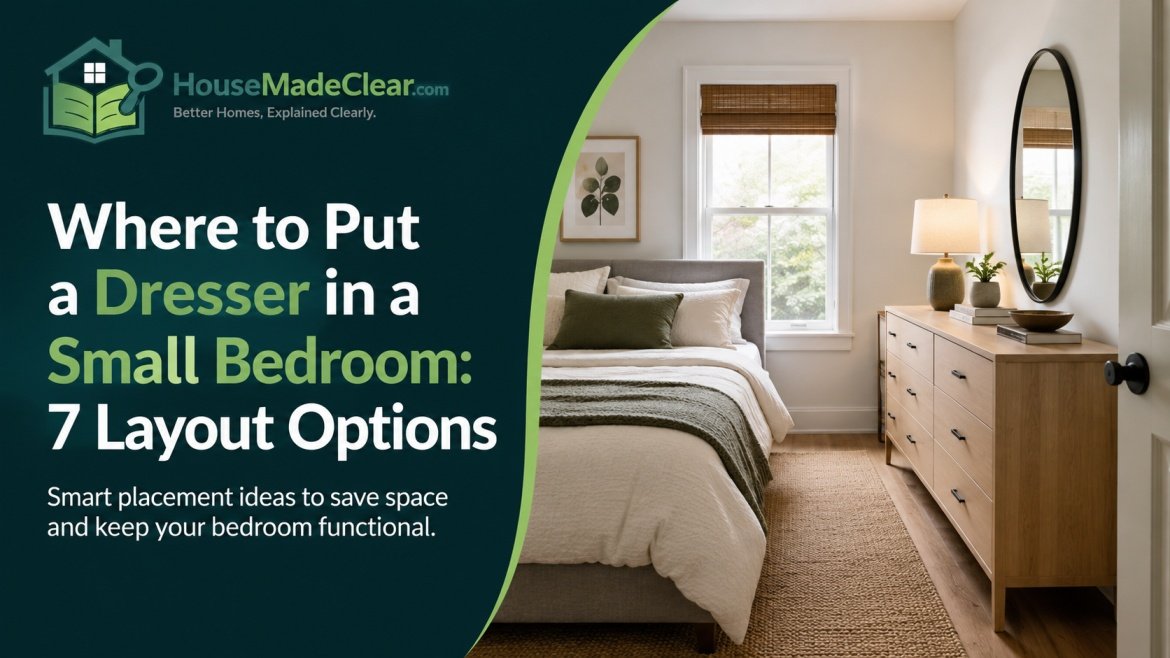
A dresser can be one of the most useful pieces of bedroom storage—and one of the hardest to place in a small room.
Put it in the wrong location and it may block a walkway, interfere with the closet or make the bedroom feel crowded. Put it in the right place and it can add useful storage without disrupting how the room functions.
The best dresser location usually depends on three things:
- Where the bed sits
- Where the door and closet open
- How much clear walking space remains
Quick Answer
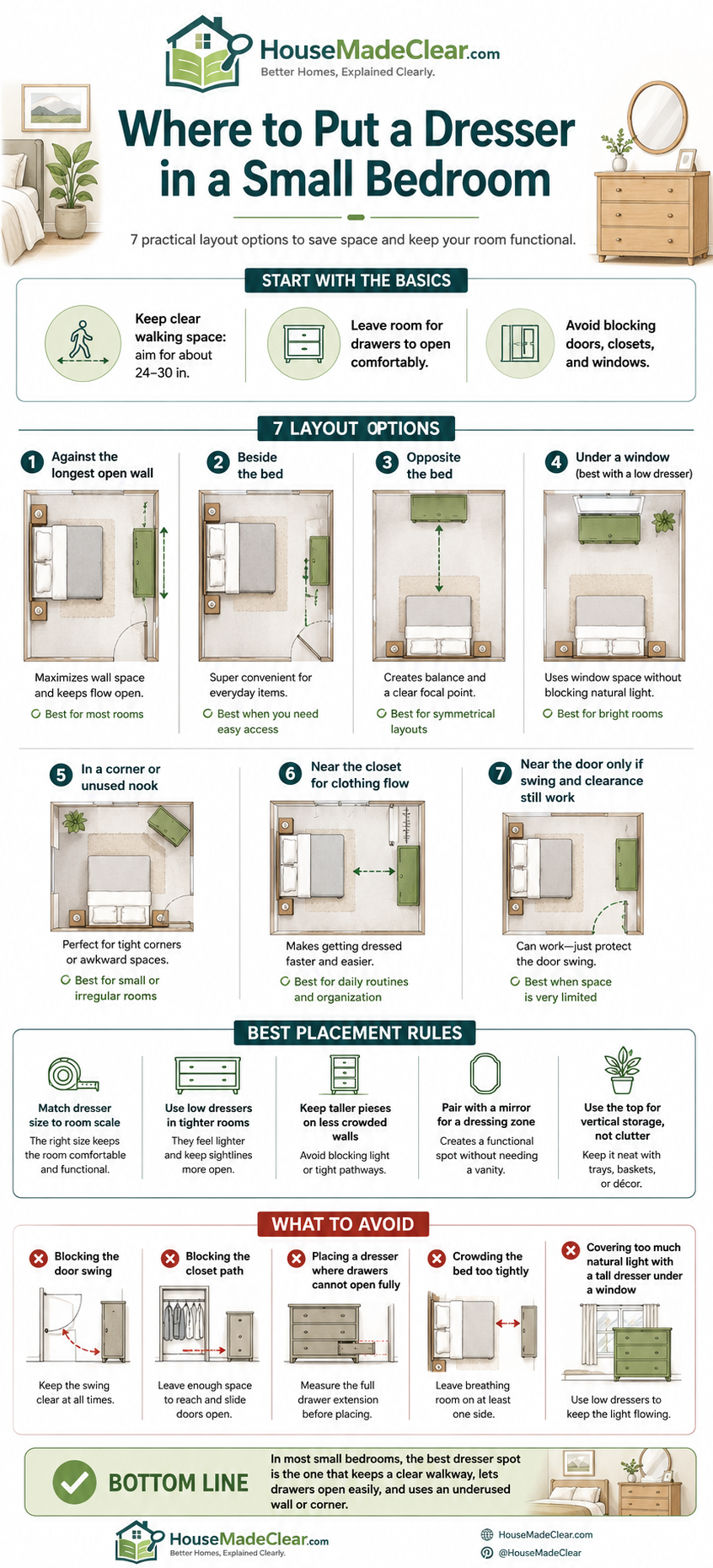
In a small bedroom, the best place for a dresser is usually against an open wall that does not interfere with the door, closet, bed or main walkway.
The most practical locations are often:
- Opposite the bed
- Beside the bed
- Under a window, if the dresser is low enough
- Inside a closet, if space allows
- Along the wall beside the door
- At the foot of the bed
- In an unused corner with a narrow dresser
Start by placing the bed first. Then use the remaining wall space for storage rather than forcing the dresser into the room before the main layout is settled.
If storage is already a challenge because the room has little or no closet space, House Made Clear’s guide to small bedroom storage ideas when you have no closet can help you decide whether a dresser should be the main storage piece or only part of the solution.
Why Dresser Placement Matters in a Small Bedroom
In a large bedroom, moving a dresser a few feet may make little difference.
In a small bedroom, it can determine whether:
- The closet opens properly
- You can walk comfortably around the bed
- Drawers can open fully
- The bedroom door clears the furniture
- The room feels balanced or overcrowded
A dresser also occupies two types of space.
Physical Space
This is the actual footprint of the furniture.
For example:
- 48 inches wide
- 18 inches deep
Operating Space
This is the extra room needed in front of it to open the drawers and stand comfortably.
A dresser that fits against a wall may still be impractical if the drawers open directly into:
- Bed
- Door
- Chair
- Narrow walkway
That is why measuring only the dresser itself is not enough.
Start With the Bed, Not the Dresser
The bed is usually the largest item in the bedroom.
So the room should generally be planned around the bed first.
A practical order is:
- Position the bed
- Check the door swing
- Check closet access
- Protect the main walkway
- Add dresser
- Add bedside storage
- Add smaller furniture only if space remains
This prevents storage furniture from dictating the entire bedroom layout.
Measure Before Moving Anything
Before testing dresser locations, record:
- Room width
- Room length
- Door width
- Door swing
- Closet width
- Closet door swing
- Window width
- Window sill height
- Bed size
- Dresser width
- Dresser depth
Also measure how far the drawers extend when fully open.
That last number is easy to forget.
A dresser may be only 18 inches deep when closed but require much more room when a drawer is opened.
How Much Space Should Be in Front of a Dresser?
There is no single number that works for every bedroom, but you need enough room to:
- Stand in front of it
- Open the drawers
- Reach inside comfortably
- Walk past without constantly bumping furniture
Rather than relying only on a fixed measurement, test the actual dresser.
Simple Test
Open the deepest drawer fully.
Stand in front of it as you normally would.
Can another person still move through the room?
Can the bed still be accessed?
Can the bedroom or closet door still open?
If not, the dresser is probably too large for that position.
1. Put the Dresser Opposite the Bed
One of the most common layouts is:
Bed on one wall → dresser on the opposite wall
This works especially well when the bedroom is long enough to maintain a usable walkway between the two.
Why It Works
The dresser:
- Creates visual balance
- Is easy to access
- Can sometimes hold a mirror
- May provide a place for a TV if desired
When It Does Not Work
This arrangement becomes difficult when:
- Room is narrow
- Bed is large
- Dresser is deep
- Drawers nearly touch the bed when open
A slim dresser may work better than a traditional deep dresser in this situation.
How to Check the Opposite-Wall Layout
Measure:
Wall-to-wall room width
Then subtract:
- Bed width
- Dresser depth
- Required movement space
For example:
Room width = 120 inches
Queen bed width = about 60 inches
Dresser depth = 18 inches
That leaves:
120 – 60 – 18 = 42 inches
This remaining space has to accommodate:
- Walking
- Drawer opening
- Bedding overhang
So the usable clearance may feel smaller than the calculation suggests.
Always test the layout physically if possible.
2. Put the Dresser Beside the Bed
A dresser beside the bed can work surprisingly well.
It may even replace a nightstand.
This is useful when:
- One wall is too narrow for both pieces
- You need more storage
- The dresser is not excessively tall
- The top remains convenient from the bed
Benefits
You eliminate one extra piece of furniture.
Instead of:
Nightstand + dresser
you use:
Dresser as nightstand
That can save floor space.
Best Dresser Type
A wider low dresser usually works better than a very tall chest if you intend to use the top beside the bed.
You may use the top for:
- Lamp
- Phone
- Book
- Water glass
But avoid overcrowding it.
When a Dresser Beside the Bed Feels Too Large
If the dresser extends significantly higher than the mattress, it may feel visually heavy.
In a very small room, consider:
- Narrow chest
- Small three-drawer dresser
- Combination nightstand/dresser
The objective is to consolidate functions rather than simply placing a large dresser beside the bed.
3. Put a Low Dresser Under the Window
A window wall is often underused.
If the sill is high enough, a low dresser can sometimes fit beneath it.
This is particularly useful when the remaining walls are occupied by:
- Bed
- Door
- Closet
- Desk
Measure the Window First
You need to know:
- Floor-to-sill height
- Dresser height
- Curtain length
- Window opening method
Do not block:
- Operable window
- Required access
- Heating equipment
- Ventilation
Dresser Height Example
Suppose:
Floor to window sill = 36 inches
Dresser height = 30 inches
That may leave enough clearance.
But if the dresser is 38 inches tall, it may overlap the window.
Curtains Can Affect This Layout
If you use floor-length curtains, a dresser directly under the window can interfere with the fabric.
Possible alternatives include:
- Dresser slightly away from the wall
- Shorter window treatment where appropriate
- Different dresser location
Do not redesign the curtains purely to make an unsuitable dresser fit.
If you are still planning the window treatment, see House Made Clear’s guides to how high to hang curtains and how wide curtains should be.
4. Put the Dresser Inside the Closet
If the bedroom has a closet but limited floor space, putting the dresser inside the closet can be one of the best solutions.
This can free up:
- Wall space
- Walking space
- Room around the bed
It Works Best When:
- Closet is deep enough
- Hanging clothes do not interfere
- Drawers can open
- Closet doors still operate
- The dresser remains easy to access
A closet does not need to contain only hanging clothes.
A combination of:
- Hanging storage
- Shelves
- Dresser drawers
can sometimes use the available volume more efficiently.
Measure Closet Depth Carefully
Do not simply push the dresser inside and hope it works.
Check:
- Closet depth
- Dresser depth
- Drawer extension
- Door opening
- Hanging-clothes clearance
A dresser beneath shorter hanging garments can work well.
For example:
Upper hanging rail
↓
Shirts/jackets
↓
Low dresser
This turns vertical space into usable storage.
5. Place the Dresser Beside the Bedroom Door
The wall beside the bedroom door is frequently overlooked.
It can work well for a narrow dresser if:
- Door opens away from it
- Furniture does not block the switch
- Entry walkway remains clear
Why This Location Can Work
The dresser sits outside the main bed zone.
That can preserve:
- Space opposite the bed
- Window wall
- Closet area
This layout is particularly useful in square bedrooms where the bed occupies the main wall.
Check the Door Swing
Always open the bedroom door fully before deciding.
The door should not:
- Hit the dresser
- Hit drawer handles
- Trap someone between door and furniture
Also make sure the dresser does not reduce the doorway clearance.
6. Put a Low Dresser at the Foot of the Bed
This is less common, but it can work in a long narrow bedroom.
Instead of placing the dresser against a wall, a low dresser can sometimes sit near the foot of the bed.
Potential Advantages
It may:
- Use otherwise empty space
- Create storage without occupying a side wall
- Work as a visual divider in a larger bedroom
But Measure Carefully
This arrangement needs enough room for:
- Walking past the dresser
- Opening drawers
- Accessing the foot of the bed
In a truly small bedroom, it may make the room feel cramped.
So this option is better for a long bedroom than a very tight square one.
Should the Drawers Face the Bed or Away?
If a dresser sits at the foot of the bed, drawer direction matters.
Drawers facing the bed may be difficult to use.
Drawers facing away may work better if there is enough clear floor space.
Test both orientations before settling on the layout.
7. Use a Narrow Dresser in an Empty Corner
Sometimes the only usable floor area is a corner.
A narrow vertical dresser can take advantage of it.
This is especially helpful where the room has:
- Short wall sections
- Multiple doors
- Large window
- Limited uninterrupted wall space
Tall vs Wide Dresser
A tall dresser:
- Uses less floor width
- Provides vertical storage
- Can fit narrow wall sections
A wide dresser:
- Uses more wall width
- Often has a larger top surface
- May feel visually lower and calmer
For a small room, the better choice depends on which dimension is more limited:
floor width or vertical height.
Tall Dresser vs Wide Dresser for a Small Bedroom
This decision matters more than many people realize.
Tall Chest of Drawers
Best when:
- Floor space is very limited
- You have an unused narrow wall
- You need more drawer volume vertically
Potential disadvantages:
- Can visually dominate a small room
- Must be stable and properly secured where required
- Top storage is less accessible
Low Wide Dresser
Best when:
- Wall width is available
- You want a mirror above it
- You want to use the top as a surface
Potential disadvantages:
- Takes more wall space
- Can interfere with circulation
Furniture Tip-Over Safety Matters
Tall dressers and chests can create tip-over hazards, especially for children.
The U.S. Consumer Product Safety Commission has long highlighted furniture tip-over risks and advises consumers to follow applicable anti-tip and anchoring guidance.
Use the furniture manufacturer’s instructions and appropriate anchoring hardware where required.
Do not assume a heavy dresser cannot tip.
Should the Dresser Face the Bed?
It can.
A dresser opposite the bed often creates a balanced layout.
It can also provide a logical location for:
- Mirror
- Artwork
- Television
But it is not a design rule.
If placing it opposite the bed creates poor circulation, another wall is better.
Function should come before symmetry.
Can a Dresser Go Next to a Closet?
Yes, if the closet remains fully usable.
Check:
- Closet door swing
- Sliding-door access
- Dresser drawer opening
- Access to closet corners
A dresser should not force you to squeeze through a narrow gap every time you use the closet.
Can a Dresser Go in Front of a Closet?
Usually, this is not ideal.
It may:
- Block access
- Reduce usable closet width
- Make storage inconvenient
However, if the closet contains unused sections or permanently inaccessible areas, some homeowners intentionally reconfigure the storage layout.
That should be a deliberate decision rather than accidental furniture placement.
Can You Put a Dresser Behind the Bedroom Door?
Sometimes, but only if the door still opens properly.
A shallow dresser may fit behind the door if:
- The door has sufficient clearance
- Handles do not collide
- The wall section is wide enough
Potential Problem
The dresser may become annoying because it is hidden every time the door is open.
If you need frequent drawer access, another location may be more convenient.
Can a Dresser Go in a Corner at an Angle?
It can, but angled furniture often wastes space in a small room.
Placing a rectangular dresser diagonally usually creates an unused triangular gap behind it.
That means you lose:
- Floor space
- Wall space
- Storage efficiency
In most small bedrooms, keeping large furniture parallel to the wall is more efficient.
Where Should a Dresser Go in a Rectangular Bedroom?
For a rectangular room, begin with the longest wall.
A common layout is:
Bed on short wall
then
Dresser on opposite short wall or long side wall
depending on room width.
Another option:
Bed on long wall → narrow dresser on opposite long wall
The best choice depends on whether the room is:
- Narrow and long
- Moderately rectangular
- Nearly square
Dresser Placement in a 10×10 Bedroom
A 10×10 bedroom offers roughly 100 square feet before furniture is added.
With a queen bed, the remaining floor area becomes limited quickly.
Good dresser locations may include:
- Opposite the bed using a shallow dresser
- Beside the bed as a nightstand replacement
- Under a suitable window
- Inside the closet
Avoid adding:
- Large dresser
- Two nightstands
- Large chair
- Desk
unless measurements confirm they fit without compromising circulation.
Dresser Placement in a 10×12 Bedroom
A 10×12 room provides slightly more flexibility.
Possible arrangements include:
Layout A
Bed on 10-foot wall
Dresser opposite
Layout B
Bed on 12-foot wall
Dresser beside bed
Layout C
Bed centered
Low dresser beneath window
The extra two feet can make a significant difference to drawer clearance.
Dresser Placement in a Bedroom With a Queen Bed
A queen mattress is approximately 60 inches wide.
That means a narrow room can become crowded quickly.
Before choosing a dresser opposite the bed:
- Measure room width.
- Subtract approximately 60 inches for bed width.
- Subtract dresser depth.
- Evaluate remaining clearance.
Example:
Room width = 120 inches
Bed = 60 inches
Dresser = 18 inches
Remaining:
42 inches
That may be workable, but you still need to consider:
- Bedding
- Drawer extension
- Walking
Dresser Placement in a Bedroom With a King Bed
A king bed takes considerably more floor width.
In a small bedroom with a king bed, prioritize:
- Narrow dresser
- Tall chest
- Closet dresser
- Bedside storage with drawers
The room may not comfortably accommodate a traditional wide dresser opposite the bed.
Do not assume every bedroom needs:
bed + two nightstands + wide dresser
A smaller number of more useful pieces may work better.
Dresser Placement Without a Closet
If the bedroom has no closet, the dresser may become part of a larger storage system.
Possible combination:
- Dresser for folded clothes
- Garment rack or wardrobe for hanging clothes
- Under-bed storage
- Wall hooks
- Seasonal storage elsewhere
House Made Clear’s guide to small bedroom storage without a closet explains how to build a storage hierarchy rather than filling every available wall with separate furniture.
Should You Use Two Dressers in a Small Bedroom?
Usually, one well-sized dresser is easier to accommodate.
But two smaller dressers may work when:
- Two people share room
- They double as nightstands
- Room has two narrow wall sections
For example:
Small dresser on each side of bed
can replace:
Two nightstands + one large dresser
That consolidates functions.
Can a Dresser Double as a Nightstand?
Yes.
This is one of the most useful small-bedroom strategies.
A dresser beside the bed can provide:
- Clothing storage
- Lamp surface
- Phone charging
- Bedside storage
This may eliminate the need for another nightstand.
Check the Height
Ideally, the top should remain reasonably convenient from the bed.
An extremely tall dresser may be awkward for bedside use.
Can a Dresser Double as a TV Stand?
Sometimes.
A low dresser can support a television if:
- Furniture is designed to carry the weight
- TV is stable
- Cable routing is safe
- Screen height is comfortable
Avoid placing the television on a piece that:
- Wobbles
- Is too narrow
- Requires unsafe cable routing
If the television is wall-mounted, House Made Clear’s guide to hiding TV cords without cutting into the wall can help keep the setup cleaner.
Can You Put a Mirror Above a Dresser?
Yes.
This is a common and practical arrangement.
A mirror can:
- Provide dressing function
- Reflect daylight
- Make the room feel more open
But size it proportionally.
A very small mirror above a very wide dresser may look disconnected.
Likewise, an oversized mirror can dominate a tiny bedroom.
Using a Dresser Under a Mirror to Brighten the Room
If the room is dark, a mirror above the dresser can sometimes reflect:
- Window
- Lamp
- Bright wall
That can help distribute existing light visually.
House Made Clear’s guide to making a dark room brighter without adding windows explains why mirrors work best when they reflect an actual light source or brighter area rather than another dark wall.
Should a Dresser Be Centered on the Wall?
Not necessarily.
Centering furniture can create visual balance, but function is more important.
You may need to shift the dresser to:
- Clear a door
- Avoid a vent
- Leave curtain space
- Maintain closet access
An intentionally off-center dresser can still look balanced with:
- Mirror
- Artwork
- Lamp
- Storage basket
Do not sacrifice circulation simply to center the furniture mathematically.
Keep the Dresser Away From Heat and Airflow Problems
Avoid blocking:
- HVAC vents
- Radiators
- Baseboard heating
- Return-air grilles
Furniture placed directly over or against heating equipment can:
- Reduce airflow
- Create uneven heating
- Affect furniture materials
Check the equipment and furniture manufacturer requirements.
Keep Curtain Clearance in Mind
If the dresser sits close to a window, check the curtains when they are:
- Fully open
- Fully closed
Wide curtain panels need stack-back space beside the window.
A dresser pushed directly against that area can:
- Crush curtain fabric
- Prevent full opening
- Reduce daylight
If you’re planning curtains at the same time, use House Made Clear’s curtain width guide before positioning storage furniture.
Dresser Placement and Electrical Outlets
Do not cover every accessible outlet with furniture.
Before moving the dresser, identify:
- Electrical outlets
- Light switches
- Internet/TV connections
If you need an outlet for:
- Lamp
- Phone charger
- TV
make sure the final furniture placement allows safe access.
Avoid routing cords where the dresser can crush or pinch them.
Dresser Placement and Bedroom Doors
Always test the door at its full swing.
It should open comfortably without:
- Hitting furniture
- Striking drawer handles
- Creating a narrow squeeze point
Also consider how the room feels when entering.
A tall dresser immediately beside the doorway may make a small bedroom feel more enclosed.
A lower piece may feel less visually heavy.
Dresser Placement and Closet Doors
Different closet doors create different constraints.
Hinged Closet Door
Needs swing clearance.
Sliding Closet Door
Requires less floor clearance but access across the opening must remain clear.
Bi-Fold Closet Door
Needs some outward operating space.
Test the closet with the dresser in position before finalizing the layout.
How to Make a Large Dresser Work in a Small Bedroom
If you already own a large dresser and do not want to replace it:
Option 1: Make It the Only Major Storage Piece
Remove smaller redundant furniture.
Option 2: Use It as a Nightstand
Shift it beside the bed.
Option 3: Place It Inside a Large Closet
If dimensions permit.
Option 4: Use Vertical Wall Space Above It
Add:
- Mirror
- Artwork
rather than another floor piece.
Option 5: Reassess the Bed Position
Sometimes rotating or shifting the bed creates a much better wall for the dresser.
How to Make a Small Dresser More Useful
If a large dresser will not fit, maximize a smaller one.
Use:
- Drawer dividers
- Vertical folding
- Small bins
- Seasonal rotation
Keep only frequently used clothing in the bedroom.
Less-used items may move to:
- Under-bed storage
- Hall closet
- Seasonal bins
A smaller dresser that works well in the room is often better than a large one that destroys circulation.
Should You Choose a Tall Dresser Instead?
A tall narrow chest can be useful when wall width is limited.
It provides more vertical storage per inch of floor width.
But consider:
- Stability
- Anchoring
- Visual weight
- Accessibility of top drawers
Tall furniture should be used carefully, particularly in homes with children.
Avoid Blocking the Main Bedroom Walkway
The most important walking route usually connects:
door → bed → closet
Keep this path reasonably clear.
Do not position the dresser so that someone has to:
- Turn sideways
- Step around open drawers
- Walk into bed corners
A small bedroom will always have tighter spacing than a large one, but furniture should not make normal movement unnecessarily difficult.
Use Painter’s Tape Before Moving Heavy Furniture
This is one of the easiest ways to test a layout.
Mark the dresser footprint on the floor using painter’s tape.
Then mark:
- Drawer extension
- Bed
- Door swing
Walk through the room.
Ask:
- Can I open the drawers?
- Can I reach the closet?
- Does the door open?
- Does the walkway feel cramped?
Testing with tape is easier than repeatedly moving a heavy dresser.
Common Dresser Placement Mistakes
1. Putting the Dresser Opposite the Bed Without Measuring
Problem:
Drawers hit the bed.
Better approach:
Measure both dresser depth and drawer extension.
2. Blocking the Closet
Problem:
Storage furniture makes other storage less accessible.
Better approach:
Protect closet opening first.
3. Using a Dresser That Is Too Deep
Problem:
It consumes excessive floor space.
Better approach:
Consider a shallower dresser.
4. Adding Both a Large Dresser and Large Nightstands
Problem:
Too much floor area is devoted to storage furniture.
Better approach:
Let a dresser replace one nightstand.
5. Blocking Curtains
Problem:
The window cannot fully open visually.
Better approach:
Leave stack-back space.
6. Ignoring Drawer Clearance
Problem:
The furniture fits only while closed.
Better approach:
Measure the open drawer.
7. Centering the Dresser at Any Cost
Problem:
Doors or pathways become compromised.
Better approach:
Prioritize function over symmetry.
8. Blocking an Outlet or Vent
Problem:
Furniture interferes with room systems.
Better approach:
Map them before moving anything.
9. Putting a Tall Dresser in the Entry Sightline
Problem:
Small room feels visually tighter.
Better approach:
Use a lower piece where possible.
10. Buying Storage Before Planning the Room
Problem:
Furniture dimensions dictate a poor layout.
Better approach:
Measure first.
7 Dresser Locations Compared
| Location | Best For | Main Concern |
|---|---|---|
| Opposite bed | Balanced layouts | Drawer clearance |
| Beside bed | Space-saving storage | Dresser height |
| Under window | Limited wall space | Sill/curtain clearance |
| Inside closet | Maximizing floor space | Closet depth |
| Beside door | Unused wall sections | Door swing |
| Foot of bed | Long bedrooms | Walkway space |
| Empty corner | Narrow vertical dresser | Visual bulk |
Step-by-Step: Find the Best Dresser Location
Step 1: Position the Bed
Start with the largest piece.
Step 2: Mark Door and Closet Swing
Do not place furniture there.
Step 3: Identify the Longest Free Wall
This is often the first dresser candidate.
Step 4: Measure the Dresser
Record:
- Width
- Height
- Depth
- Drawer extension
Step 5: Test Opposite the Bed
If clearance is poor, move on.
Step 6: Test Beside the Bed
See whether it can replace a nightstand.
Step 7: Check Under the Window
Only if sill height and curtains allow.
Step 8: Check the Closet
A closet dresser may free up the entire room.
Step 9: Test the Walkway
Walk from:
- Door to bed
- Bed to closet
Step 10: Open Every Drawer and Door
Do not approve a layout based only on closed furniture.
Quick Dresser Placement Box
Best Small-Bedroom Rule
Place the bed first.
Then choose the dresser location that:
- Does not block the bedroom door
- Does not block the closet
- Allows drawers to open
- Keeps the main walkway usable
- Does not interfere with curtains or windows
If a dresser requires you to compromise two or more of those points, it is probably too large or in the wrong position.
Small Bedroom Dresser Checklist
Before settling on the placement, confirm:
- Bed position finalized
- Bedroom door opens fully
- Closet opens fully
- Dresser drawers open fully
- Main walkway remains usable
- Dresser does not block window
- Curtains can still open
- Dresser does not cover important vent
- Outlet remains accessible where needed
- Cords are not pinched
- Furniture is stable
- Tall furniture is secured where required
- Mirror placement works if used
- Top surface remains functional
- Dresser does not visually dominate the room
Final Thoughts
The best place for a dresser in a small bedroom is usually the location that gives you useful storage without making normal movement difficult.
Start with the bed.
Then evaluate:
- Opposite wall
- Bedside wall
- Window wall
- Closet
- Door wall
- Foot of bed
- Empty corner
For many small rooms, the strongest options are:
Opposite the bed if there is enough clearance
Beside the bed if it can replace a nightstand
Inside the closet if floor space is extremely limited
Do not judge the layout only by whether the dresser physically fits.
Open:
- Drawers
- Bedroom door
- Closet
and actually walk through the space.
If every function works comfortably, the placement is probably suitable.
And if your bedroom has very limited clothing storage overall, continue with House Made Clear’s Small Bedroom Storage Ideas When You Have No Closet guide for wardrobe alternatives, under-bed storage and ways to use vertical space.
Frequently Asked Questions
Where is the best place to put a dresser in a small bedroom?
The best location is usually an open wall that does not interfere with the bed, bedroom door, closet or main walkway. Common options include opposite the bed, beside the bed or under a window if there is sufficient clearance.
Can you put a dresser beside the bed?
Yes. A dresser beside the bed can work especially well in a small room because it can replace a nightstand and provide more storage without using an additional furniture footprint.
Can a dresser go under a bedroom window?
Yes, if the dresser is lower than the window sill and does not block window operation, heating equipment or curtain movement. Measure the sill height before choosing the dresser.
Is it okay to put a dresser inside a closet?
Yes. A dresser inside a sufficiently large closet can free valuable bedroom floor space. Make sure the drawers open fully and hanging clothes or closet doors do not interfere.
Should a dresser be opposite the bed?
It can be a good layout because it creates visual balance, but only if there is enough space between the bed and dresser to walk and open the drawers comfortably.
Can a dresser replace a nightstand?
Yes. Using a small or medium dresser beside the bed can combine clothing storage and bedside storage, which is particularly useful in a small bedroom.
Is a tall or wide dresser better for a small bedroom?
A tall dresser can save wall width and use vertical space, while a low wide dresser may feel less visually heavy and provide a larger top surface. The better option depends on the available wall and floor space.
How much space do you need in front of a dresser?
You need enough room to fully open the drawers and stand comfortably while using them without blocking the main walkway. The exact clearance depends on drawer depth and the room layout.
Can a dresser go at the foot of the bed?
It can work in a long bedroom if sufficient walking and drawer clearance remains. In very small rooms, however, this arrangement can make circulation too tight.
Should a dresser be centered on the wall?
Not necessarily. Centering can look balanced, but it is more important to maintain door clearance, closet access, curtain movement and a usable walkway.